
BooksFantasy
The Wonderful Wizard of Oz
See how L. Frank Baum and W. W. Denslow made Oz in 1900, from American biography and publication to adaptations and learner-friendly prose.
About the book
The Wonderful Wizard of Oz: History, Reception and Reading Guide
About the author
Lyman Frank Baum (1856–1919) was born in Chittenango, New York, and preferred his middle name. He was the seventh of nine children, five of whom survived to adulthood. His father worked in barrel-making, oil drilling, and real estate; Baum grew up at Rose Lawn in Mattydale and was educated partly at home.
Baum tried several careers before Oz. He attended Peekskill Military Academy for two years, started amateur journals with his brother Henry, issued a stamp-dealer directory at seventeen, bred Hamburg chickens, and published The Book of the Hamburgs in 1886. He wrote plays, moved with his wife to Aberdeen in 1888, opened Baum’s Bazaar, and edited The Aberdeen Saturday Pioneer.
In Chicago he turned more fully to children’s writing. Mother Goose in Prose (1897) and Father Goose, His Book (1899) established a path toward the book that made him famous.
How and when it was written
Baum and illustrator W. W. Denslow published The Wonderful Wizard of Oz in the United States in September 1900 through the George M.
Hill Company. The book was illustrated by Denslow and became the first Oz novel. The saved history does not give a single dated drafting session or a complete manuscript trail; what it does show is the professional route behind the work: Baum’s newspaper, stage, sales, and children’s-book experience, followed by a major collaboration with Denslow.
The title matters. The later 1902 musical used the shortened The Wizard of Oz, and many subsequent editions followed it. The original novel’s title identifies a specific 1900 book, while the shorter phrase became the label for a much larger adaptation tradition.
What the story is about
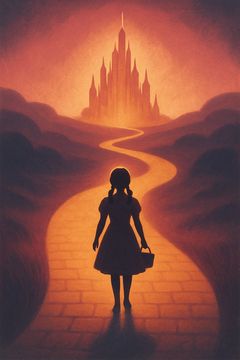
Dorothy Gale lives on a Kansas farm with Aunt Em, Uncle Henry, and her dog Toto. A cyclone carries the girl and dog to the Land of Oz, where Dorothy learns that returning home requires confronting the Wicked Witch of the West. Along the road she meets a Scarecrow who wants a brain, a Tin Woodman who wants a heart, and a Lion who wants courage.
Their journey is a sequence of encounters with strange landscapes, rulers, dangers, and promises; this introduction avoids the resolution.
How it was received
The book met critical acclaim and financial success. It was the best-selling children’s book for two years after publication and had sold three million copies by the time it entered the public domain in 1956. Its success prompted Baum to write thirteen additional official Oz novels.
A 1902 stage musical opened in Chicago, reached Broadway for 293 nights from January to October 1903, returned later that year, and toured the United States until 1911. The 1939 film became a landmark of twentieth-century cinema. The Library of Congress has called the book America’s greatest and best-loved homegrown fairy tale.
Baum’s route to Oz helps explain its American sense of motion. He had handled newspapers, retail, theatre, poultry publishing, and children’s verse before creating a farm girl whose home is specific but whose journey becomes enormous in imaginative scale. Denslow’s pictures were an essential part of the 1900 collaboration.
The result encourages readers to remember colors, bodies, roads, and recurring companions. Later stage and film forms changed the cultural vocabulary around the novel, so readers should separate Baum’s printed wording from lines made famous elsewhere. The three-million-copy figure by 1956 and thirteen official sequels show that Oz became a publishing system as well as a single fantasy.
Why it works for language learners
Baum’s sentences are generally direct, with repeated travel patterns and dialogue that make the adventure accessible. Learners meet American place vocabulary, simple past narration, commands, descriptive color words, and formulaic introductions. Chapters are short enough to support regular practice, while invented names and fantasy nouns require contextual guessing.
Useful public-domain phrases include “There’s no place like home,” “Pay no attention to that man behind the curtain,” and “You have plenty of courage.” The first two are especially associated with later adaptations, so readers should compare which wording belongs to Baum’s novel and which belongs to its stage or film descendants.
Sources
Source text / credits: The Wonderful Wizard of Oz — Wikipedia · L. Frank Baum — Wikipedia · Project Gutenberg: The Wonderful Wizard of Oz
Frequently asked questions
How many chapters are listed for this edition of The Wonderful Wizard of Oz?
The catalog lists 24 chapters for this edition.
Where are the article sources?
The article lists its references in the Sources section at the end.
 A Midsummer Night's Dream
 Alice's Adventures in Wonderland
 Peter Pan
 The Water-Babies
 A Connecticut Yankee in King Arthur's Court
 A Tale of Two Cities