
BooksFantasy
Alice's Adventures in Wonderland
Learn how Lewis Carroll created Alice's Adventures in Wonderland, how Victorian readers received it, and why its playful English rewards learners today.
About the book
Alice's Adventures in Wonderland: History and Reception
About the author
Lewis Carroll was the pen name of Charles Lutwidge Dodgson, a mathematician, logician, photographer and writer associated with Christ Church, Oxford. His mathematical interests are relevant to Alice’s Adventures in Wonderland: the book’s jokes often turn rules, categories and logical expectations upside down. Carroll was also an amateur photographer by the late 1850s, and twenty surviving photographs of Alice Liddell are mentioned in the historical record.
Carroll had known the Liddell children since about March 1856. Their father was Henry Liddell, dean of Christ Church. The three sisters in the famous boating party were Lorina Charlotte, aged thirteen; Alice Pleasance, aged ten; and Edith Mary, aged eight.
Carroll’s Oxford life, his friendships with the family, and his habits of inventing puzzles gave the future book a very particular setting: an academic city transformed into a landscape of nonsense.
The relationship between the real Alice and the fictional Alice remains debated. Scholars differ about how closely the character was based on Alice Liddell. Carroll’s name for himself also enters the book’s comic machinery: he stuttered, and “Dodo-Dodgson” has been read as the source of the Dodo character.
These details do not reduce the novel to a private code. They show how a local friendship, Victorian childhood and wordplay were reshaped into a book with an international life.
Carroll’s professional surroundings supplied another layer. Christ Church was a place of mathematics, classical languages and formal ceremony, yet the story repeatedly makes ceremonious behaviour look absurd. That contrast helps explain why the book can feel both specifically Victorian and strangely modern: its jokes question who gets to define a rule, a lesson or a sensible answer.
How and when it was written
The story was conceived on 4 July 1862, when Carroll and the Reverend Robinson Duckworth rowed about five miles from Folly Bridge to Godstow on the River Isis near Oxford. During the trip he told the three Liddell sisters a story called “Alice’s Adventures Under Ground”. Alice asked him to write it down.
Carroll began the manuscript the next day, expanded the plot during another boat trip a month later, and began work in earnest in November.
He researched natural history for the animals and showed the work to other children, especially those of George MacDonald. Carroll first supplied his own illustrations, but was advised to engage a professional. He approached John Tenniel, already known as a Punch cartoonist, to reinterpret the scenes.
The handwritten manuscript, with Carroll’s illustrations, was given to Alice on 26 November 1864 as a Christmas gift in memory of a summer day.
The published book, issued by Macmillan in November 1865, was about twice as long as Alice’s Adventures Under Ground. It added episodes including the Mad Hatter’s tea party. Tenniel made forty-two wood-engraved illustrations for the edition.
The first print run was destroyed or sold in the United States at Carroll’s request because Tenniel disliked the printing quality; the book was reprinted in 1866. The only known manuscript copy of Under Ground is held by the British Library, which makes the drafting history unusually tangible.
What the story is about
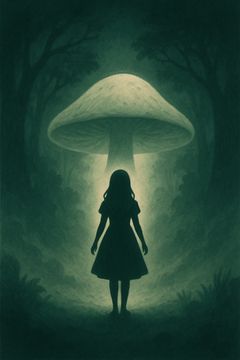
Alice is sitting beside her sister when she notices a White Rabbit wearing a waistcoat and carrying a pocket watch. She follows him down a rabbit hole and arrives in a room with a tiny door and a garden beyond it. A bottle marked “Drink me” and a cake marked “Eat me” begin a series of changes in her size, memory and confidence.
In Wonderland she meets a mouse, a Dodo, a Caterpillar, a Cheshire Cat, a Duchess, the Hatter, the March Hare and the Dormouse. Their conversations make language itself unstable: a riddle may refuse an answer, a poem may be remembered incorrectly, and a familiar rule may work in an unfamiliar way. The Queen of Hearts governs a court of playing cards, while a Gryphon and Mock Turtle introduce Alice to songs, lessons and a trial.
This is a setup, not an ending: the pleasure lies in seeing how Alice tests every rule she is given.
How it was received
The novel received positive reviews on release and became one of the best-known works of Victorian literature. It is described as a landmark of literary nonsense and as a book that helped move children’s writing away from instruction toward delight and entertainment. It has never been out of print, has been translated into 174 languages, and has influenced fantasy, popular culture and children’s literature.
Its afterlife is unusually broad. Adaptations include screen and radio productions, visual art, ballet, opera, musical theatre, theme parks, board games and video games. Carroll published Through the Looking-Glass in 1871 and The Nursery “Alice” in 1890.
The historical record also names later critical approaches: Morton N. Cohen reads the book as a roman à clef, while Jan Susina rejects too close an identification between Alice Liddell and the character. Gillian Beer and Melanie Bayley are among the critics who have examined the book’s language, science and logic.
Why it works for language learners
This is a demanding but lively book for learners because its English changes register constantly. Alice uses polite Victorian conversation, formal questions, schoolroom grammar and direct disagreement. The chapters are compact, and the scenes are visually distinct, which makes it easy to review a short passage.
The difficulty comes from puns, archaic expressions and poems rather than from long technical exposition.
Short public-domain phrases worth noticing include “Curiouser and curiouser!”, “Why is a raven like a writing-desk?”, and “It’s the stupidest tea-party I ever was at in all my life!” They illustrate an invented comparative, a deliberately unanswered riddle, and emphatic conversational syntax. Learners can also watch how “said”, “thought”, “began”, and “went on” keep a fast dialogue moving.
Alice’s Latin declension joke and the cross-language “pomme de terre” pun show that the book invites attention to how words travel between systems.
Sources
Source text / credits: Alice's Adventures in Wonderland — Wikipedia · Lewis Carroll — Wikipedia · Project Gutenberg: Alice's Adventures in Wonderland
Frequently asked questions
How many chapters are listed for this edition of Alice's Adventures in Wonderland?
The catalog lists 12 chapters for this edition.
Where are the article sources?
The article lists its references in the Sources section at the end.
 A Midsummer Night's Dream
 Peter Pan
 The Water-Babies
 The Wonderful Wizard of Oz
 A Connecticut Yankee in King Arthur's Court
 A Tale of Two Cities