
BooksDrama
A Tale of Two Cities
Explore Dickens's 1859 historical novel: its London and Paris setting, serial publication, Revolution-era research, reception, and learner-friendly style.
About the book
A Tale of Two Cities: History, Reception and Reading
About the author
Charles Dickens was born at Portsmouth on 7 February 1812 and spent formative years in Chatham and London. When his father was imprisoned for debt in 1824, the twelve-year-old Dickens worked at Warren’s Blacking factory; the experience later shaped his sympathy for children exposed to poverty and institutions. He educated himself in the British Museum reading room, became a parliamentary reporter, and published Sketches by Boz in 1836.
Dickens edited journals, gave public readings, and wrote serial fiction under intense deadlines. Oliver Twist (1837–39), David Copperfield (1849–50), and Bleak House (1852–53) established his social and comic range. His interest in the French Revolution was sharpened by Thomas Carlyle’s The French Revolution: A History (1837), a major historical influence on this novel.
How and when it was written
Dickens published A Tale of Two Cities in 1859. It is set in London and Paris before and during the French Revolution, and its three books move from imprisonment and family memory toward revolutionary violence. The historical frame allowed Dickens to connect private suffering—especially Dr Manette’s eighteen-year confinement in the Bastille—with public upheaval.
The novel appeared in Dickens’s weekly periodical All the Year Round, which he had founded in 1859, making its short chapters and cliff-hanger turns especially important. The Gutenberg text preserves the architecture of “Book the First,” “Book the Second,” and “Book the Third.” Dickens’s famous opening—“It was the best of times, it was the worst of times”—sets paired opposites before the plot introduces the Manette family, Lucie, Charles Darnay, and Sydney Carton.
What the story is about
Dr Manette leaves the Bastille and travels to London to meet Lucie, his daughter, whom he has never known. Their lives intersect with Darnay, Carton, Jarvis Lorry, and the Defarges as political anger grows in France. The story asks how inherited guilt, loyalty, and sacrifice behave when a society turns against its ruling class.
This introduction avoids the ending and its central revelation.
How it was received
The book became Dickens’s best-known historical novel and is often described as one of the best-selling novels ever written. In the BBC’s 2003 Big Read poll it ranked 63rd. That later popularity sits beside the novel’s continuing adaptations for film, television, radio, and stage.
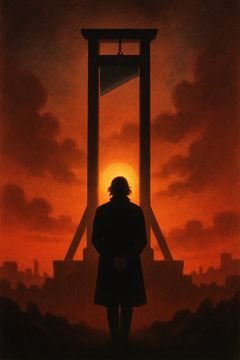
John McLenan illustrated the serial edition, including the seamstresses and the guillotine scenes.
Critics have disagreed about Dickens’s revolution. Some readers value the novel’s compassion for the poor and its warning about aristocratic cruelty; others find its crowd scenes melodramatic or its history simplified. Its most durable influence may be structural: the opening antithesis, the recurring “golden thread,” and Carton’s moral vocabulary have become part of popular literary culture.
Why it works for language learners
The novel’s three-book structure offers clear milestones, and many chapters are short enough for a daily reading routine. Dickens alternates direct dialogue with vivid narrator commentary, so learners see both conversational English and elaborate Victorian description. Useful public-domain phrases from the Gutenberg text include “It was the best of times,” “Recalled to Life,” and “It is a far, far better thing.”
They are brief, memorable examples of repetition, headline-like compression, and formal comparison.
The difficulty is uneven: political nouns (Bastille, émigré, tribunal), historical references, and long periodic sentences demand patience, while the dialogue gives frequent support. Learners can track the paired cities, repeated images, and chapter titles as a vocabulary map.
Dickens also repeats names and images with deliberate clarity. “Golden thread” language, knitting, footsteps, and echoes help a reader remember who belongs to which household even when the revolution widens the cast. A learner can read the chapter title first, predict its vocabulary, and then check that prediction against the paragraph’s concrete verbs.
Learners can track the novel’s repeated contrasts: London and Paris, public crowd and private room, imprisonment and release, silence and speech. The historical vocabulary is substantial, but Dickens often explains a setting through action. Read a short scene aloud, tap a word for help, and then revisit the same paragraph to notice how repetition builds political and emotional pressure.
That influence helps explain the novel’s selective history. Dickens was not trying to write a full chronology of 1789; he used Carlyle’s revolutionary narrative to frame personal imprisonment, inherited anger, and the danger of turning justice into vengeance. The weekly format of All the Year Round then converted that historical pressure into short units, each one balancing a public event against a private household.
The result is research transformed into serial suspense rather than a textbook account.
The book’s later life confirms how portable that design became. The saved history records adaptations for film, television, radio, and stage, including Jack Conway’s 1935 film. Each medium can preserve a different center: the printed novel can linger over the narrator’s antitheses, a radio version can make footsteps and voices political, and a film can turn the guillotine crowd into a visual machine.
Dickens’s historical influence therefore survives through repeated acts of re-staging.
A useful learner paragraph is to trace one pair of opposites through a short chapter: London/Paris, silence/speech, prison/release, or crowd/room. Write two sentences using the same noun in each setting, then compare the verbs around it. Dickens’s historical argument becomes easier to hear when the vocabulary is treated as a pattern of movement rather than a collection of difficult names.
The three-book plan makes that comparison practical. Read one short chapter from “Recalled to Life,” “The Golden Thread,” or “The Track of a Storm,” and record its dominant verb before naming its theme. Dickens often lets a concrete action—returning, knitting, hiding, marching—carry the historical meaning.
Learners can then revisit the chapter title and ask whether the verb has widened from one person’s experience to a crowd’s.
Sources
Source text / credits: A Tale of Two Cities — Wikipedia · Charles Dickens — Wikipedia · Project Gutenberg: A Tale of Two Cities
Frequently asked questions
How many chapters are listed for this edition of A Tale of Two Cities?
The catalog lists 45 chapters for this edition.
Where are the article sources?
The article lists its references in the Sources section at the end.
 Anna Karenina
 Great Expectations
 Madame Bovary
 The Scarlet Letter
 A Connecticut Yankee in King Arthur's Court
 A Midsummer Night's Dream