
BooksFantasy
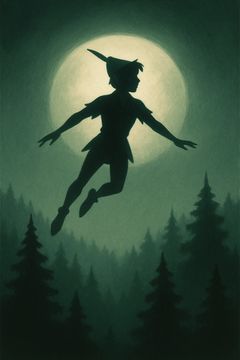
Peter Pan
Follow J. M. Barrie’s Peter Pan from its 1904 stage origin to the 1911 novel, critical debate, adaptations, and language-learning possibilities.
About the book
Peter Pan by J. M. Barrie: History and Reception
About the author
James Matthew Barrie was born in Kirriemuir, Scotland, on 9 May 1860 and died in London on 19 June 1937. He studied at the University of Edinburgh and moved to London, where he worked as a journalist before becoming a novelist and playwright. His early fiction drew on Scottish life, while his later theatre made him one of the best-known dramatists of Edwardian Britain.
Barrie’s friendship with the Llewelyn Davies family helped shape Peter Pan. The boys George, Jack, Peter, Michael, and Nicholas became part of the imaginative circle behind the character, although the literary figure is not a literal biography of one child. Barrie gave the copyright in his Peter Pan works to Great Ormond Street Hospital in 1929, an unusual and lasting act of literary philanthropy.
How and when it was written
Peter Pan first became famous in the stage play Peter Pan, or The Boy Who Wouldn’t Grow Up, which opened in London on 27 December 1904. Barrie had already introduced the character in the 1902 novel The Little White Bird. The novel commonly read today, Peter and Wendy, was published by Hodder & Stoughton in 1911 and later became known as Peter Pan.
The 1911 book is not simply a transcript of the play. Barrie expanded narration, description, and the psychology of Wendy, John, Michael, and Peter. The sources do not claim one fixed drafting schedule or a single “first” manuscript, so those details are omitted.
What is secure is the sequence: 1902 appearance, 1904 play, and 1911 novel.
The book also carries the marks of theatre. Entrances, exits, stage-like reveals, and spoken cues remain important even when the narrator moves freely through the Darling house and Neverland. That hybrid quality helps explain why the story crosses between performed adventure and prose while retaining a strong narrative voice.
The 1911 edition was part of a continuing publication history. Barrie’s 1902 The Little White Bird had already introduced Peter, and the 1904 stage success supplied the public character later expanded in prose. In 1928 Barrie published the play itself, allowing readers to compare its theatrical timing with the novel’s narrator.
What the story is about
Wendy Darling lives in London with her parents and brothers John and Michael. One night Peter Pan enters the nursery with Tinker Bell, a fairy whose light and temper are closely tied to the story’s magic. Peter invites the children to fly to Neverland, where lost boys, pirates, mermaids, and Native inhabitants make a world governed by play and danger.
The setup follows the children’s departure and their arrival in an island adventure. Captain Hook supplies a rival imagination: he wants order, revenge, and control, while Peter resists adulthood itself. The novel’s charm is accompanied by darker questions about memory, time, and the cost of refusing to grow up.
How it was received
The 1904 play was a major theatrical success and made Peter Pan a cultural icon. The 1911 novel extended that success into children’s literature. Later readers have praised Barrie’s invention, narrative voice, and mixture of comedy with melancholy, while critics have also examined the book’s treatment of gender, empire, race, and childhood.
The story has generated numerous adaptations: the 1924 silent film, Disney’s animated Peter Pan in 1953, Steven Spielberg’s Hook in 1991, and the live-action Peter Pan in 2003 are among the best-known. These versions differ widely, but the 1904 play and 1911 novel remain the primary literary sources for the familiar character.
Barrie’s original work is not only cheerful fantasy. The narrator repeatedly reminds readers that childhood passes, memories change, and adventure has consequences. Modern productions often soften or revise elements that now attract criticism, making it useful to distinguish the historical text from later family entertainment.
The adaptation record includes the 1924 silent film, Disney’s 1953 animated film, Spielberg’s Hook (1991), and the 2003 live-action film. Barrie’s 1929 decision to give the copyright in his Peter Pan works to Great Ormond Street Hospital adds a rare institutional chapter to reception history.
Why it works for language learners
Barrie alternates brisk dialogue with a narrator who talks directly to the reader. Nursery speech, pirate commands, fairy vocabulary, and playful repetitions make the English memorable. Chapters often contain a clear episode, though the idiom and irony can be more advanced than the fairy-tale setup suggests.
The Gutenberg text offers short phrases such as “Come with me,” “I can fly,” and “The children were asleep.” These give learners imperatives, modal verbs, and past continuous or simple past in an immediately understandable setting. A parallel edition is useful for catching the narrator’s jokes and sudden changes from wonder to threat.
The changing setting creates useful vocabulary groups: nursery objects, flight, pirates, theatre-like commands, and imagined geography. Learners can compare the narrator’s playful asides with the children’s direct speech and Captain Hook’s theatrical threats. Short scenes, repeated names, and physical movement make it possible to reread a passage for idiom without losing the larger adventure.
Begin with “Come with me,” “I can fly,” and “The children were asleep.” The first two sentences use an imperative and a modal verb to invite belief; the third anchors the fantastic scene in ordinary past description. Learners can label speaker, verb, and certainty.
Sources
Source text / credits: Peter Pan — Wikipedia · J. M. Barrie — Wikipedia · Project Gutenberg: Peter Pan
Frequently asked questions
How many chapters are listed for this edition of Peter Pan?
The catalog lists 17 chapters for this edition.
Where are the article sources?
The article lists its references in the Sources section at the end.
 A Midsummer Night's Dream
 Alice's Adventures in Wonderland
 The Water-Babies
 The Wonderful Wizard of Oz
 A Connecticut Yankee in King Arthur's Court
 A Tale of Two Cities