
BooksRussian classics
The Cossacks
Read the history behind Tolstoy's 1863 novella about a young Russian in the Caucasus, its research, reception, influence, and English style.
About the book
The Cossacks by Leo Tolstoy: History and Reception
About the author
Born at Yasnaya Polyana in Tula Governorate on 9 September 1828, Leo Tolstoy died at Astapovo station on 20 November 1910. He belonged to an aristocratic family and inherited the estate after his parents died: his mother in 1830 and his father in 1837. He studied oriental languages and law at Kazan University from 1844, left without graduating, and joined the army in 1851.
Tolstoy served in the Caucasus and later in the Crimean War, including the defence of Sevastopol in 1854–55. His early stories appeared in The Contemporary, and Childhood was published in 1852. He opened a school for peasant children at Yasnaya Polyana in 1859 and married Sophia Behrs in 1862.
The mixture of military memory, estate life, moral scrutiny, and educational experiment prepared the ground for The Cossacks.
How and when it was written
Tolstoy first visited the Caucasus in 1851 and used that experience in a work eventually titled The Cossacks: A Tale of 1852. He worked on it for years, revising it after returning to Yasnaya Polyana. The novella appeared in The Russian Messenger in 1863, after long delays and editorial difficulties.
Its publication followed The Sevastopol Sketches and preceded War and Peace (1869).
The narrative’s details are grounded in observation: military outposts, hunting, Cossack customs, mountain geography, Russian officers, and the Chechen frontier. Tolstoy gives the young nobleman Olenin a romantic expectation of “natural” life, then tests that fantasy against actual people. The work’s attraction is therefore double: it offers a vivid frontier world while quietly exposing the outsider’s habit of turning other communities into moral scenery.
Tolstoy’s later revisions help explain the novella’s unusual combination of freshness and delay. He carried the Caucasus material from his early army years into a different literary and moral maturity. The published story is not a military report: hunting scenes slow the action, village routines receive close attention, and Olenin’s self-explanations are repeatedly measured against what Maryanka, Lukashka, and Eroshka actually do.
The landscape becomes a test of perception rather than a decorative backdrop.
Its compressed form makes every social encounter carry unusual weight.
The result is a focused bridge between military memory and mature realism.
The decade-long gestation is important. Tolstoy carried a Caucasus project from the soldier’s notebook into a finished literary work, and the subtitle A Tale of 1852 preserves the historical moment he was reworking. The Russian Messenger publication in 1863 placed that remembered frontier beside the political and social concerns of a later decade.
It also explains why the novella feels both immediate and retrospective: its sensory detail comes from lived observation, while its moral testing belongs to the older writer.
The story is not a neutral ethnography. Tolstoy’s Russian officer arrives with ideas about freedom and “natural” life, but the Cossack community has its own work, kinship, danger, and codes. The Caucasus tradition had already been shaped by Pushkin and Lermontov; Tolstoy’s contribution is to make an outsider’s romantic gaze itself part of the subject.
What the story is about
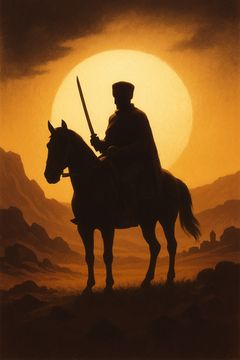
Dmitri Olenin leaves Moscow after wasting his inheritance and becomes a junior officer in the Caucasus. At a Cossack village he meets the hunting-loving old man Eroshka, the young Cossack Lukashka, and Maryanka, whose beauty and self-possession disturb his plans for self-renewal. Olenin wants to belong to the landscape and its people; military duty, desire, class, and the frontier’s violence resist that wish.
The setup ends before its decisive consequences.
How it was received
The 1863 publication established the work as an important early Tolstoyan narrative, though Tolstoy’s later fame through War and Peace and Anna Karenina changed how readers positioned it. Critics have valued its psychological contrast between Olenin and Eroshka and its unusually concrete Caucasus setting. Later readers connect it with Tolstoy’s recurring critique of aristocratic privilege and his search for a moral life outside convention.
The story also belongs to the Caucasus literature produced by Russian writers including Alexander Pushkin and Mikhail Lermontov, while Tolstoy’s treatment is more ethnographically attentive than a simple adventure romance.
Why it works for language learners
The novella is shorter than Tolstoy’s major novels and has a clear movement between camp, village, hunt, and mountain landscape. Learners meet military vocabulary, Russian names, Cossack social terms, and descriptive sentences whose verbs are often concrete. Short public-domain phrases include “I have come to the Caucasus,” “the old Cossack,” and “the moon was rising.”
The prose can still be challenging because Tolstoy shifts from landscape detail to interior reflection, but the compact cast makes that transition easier to track.
Sources
Source text / credits: The Cossacks — Wikipedia · Leo Tolstoy — Wikipedia · Project Gutenberg: The Cossacks
Frequently asked questions
How many chapters are listed for this edition of The Cossacks?
The catalog lists 42 chapters for this edition.
Where are the article sources?
The article lists its references in the Sources section at the end.
 Boyhood
 Childhood
 Family Happiness
 Father Sergius
 Hadji Murat
 Master and Man