
BooksRussian classics
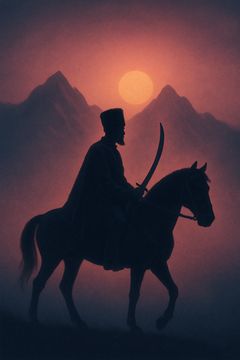
Hadji Murat
Read the history behind Tolstoy's Hadji Murat, its Caucasus setting, critical reputation, and the concrete language challenges it offers learners.
About the book
Hadji Murat by Tolstoy: History, Context and Reception
About the author
Leo Tolstoy was born in 1828 into the Russian nobility at Yasnaya Polyana. He studied at Kazan University, joined the army in 1851, served in the Caucasus, and fought at Sevastopol during the Crimean War. Those years gave him direct knowledge of military bureaucracy, frontier geography, and the competing loyalties that later shape Hadji Murat.
After War and Peace and Anna Karenina, Tolstoy’s fiction became more openly concerned with violence, conscience, and the moral cost of state power. He died in 1910 while traveling and was buried at Yasnaya Polyana. Hadji Murat is a late work: its historical material reaches back to the Caucasus campaigns, but its compressed narrative reflects Tolstoy’s mature suspicion of official heroism.
How and when it was written
Tolstoy began the story in 1896 and worked on it for years; it was published posthumously in 1912. The book record gives the title as Hadji Murat, though the historical figure’s name is also rendered Hadji Murad. The story draws on the real Avar leader who broke with Imam Shamil and attempted to negotiate with Russian forces during the Caucasian War.
Tolstoy’s notebooks show that he kept returning to the subject while working on other projects. Rather than present a single official explanation, he assembles reports, conversations, military orders, domestic scenes, and memories. The opening image of a crushed thistle frames the story as an encounter with stubborn life.
That small natural object prepares the reader for a narrative in which people are treated as instruments by commanders on several sides.
What the story is about
Hadji Murat leaves Shamil after a political rupture and seeks Russian protection. His immediate aim is practical: he wants to rescue family members held by his former ally. Russian officers see a valuable defector, while Hadji Murat sees the army as a possible route to his family.
The story moves between his camp, Russian headquarters, the imperial court, and the households affected by the war.
The contrast between the front and St Petersburg is deliberate. Nicholas I appears through court ritual and imperial vanity, while soldiers and villagers experience requisitions, fear, and orders from far away. The narrative gives Hadji Murat courage and tactical intelligence without turning him into a flawless emblem.
Its tragedy grows from incompatible systems of loyalty, not from a puzzle whose ending should be announced here.
How it was received
The work appeared after Tolstoy’s death and quickly became one of the most admired late novellas. Critics praised its economy, battlefield realism, and refusal to divide the Caucasian conflict into simple heroes and villains. Later scholars have connected it to Tolstoy’s own military memories and to his late opposition to imperial violence.
Its international reputation grew through translations and collected editions. The story has inspired stage, radio, and screen adaptations, but the source record used here does not establish a complete list of titles and years, so this article does not invent one. What can be stated securely is its durable place beside Tolstoy’s shorter masterpieces: a historical narrative valued for exact observation and moral compression.
Tolstoy’s choice of a real Caucasus conflict gives the novella a documentary pressure without making it a chronicle. The Russian Empire’s military presence, Shamil’s authority, the Avar political world, and the imperial court all appear through different scales of attention. A commander reads a report; a family waits for news; a ruler turns a war into an item of state policy.
The short form can hold these contrasts because each scene is sharply selected rather than exhaustively explained.
The novella is also valuable for learning how historical fiction distributes information. A military report may compress a human crisis into a few lines; a domestic scene may reveal what the report omits. Learners can compare formal descriptions with spoken exchanges and identify who has the power to name an event.
That is a language exercise and a central part of Tolstoy’s criticism of war.
Why it works for language learners
Hadji Murat rewards learners who enjoy changing viewpoints. Chapters are concise, but the vocabulary ranges from military ranks and Caucasus place names to domestic Russian life and imperial ceremony. Dialogue often carries political danger beneath polite wording.
Public-domain phrases include “The thistle was crushed,” “Hadji Murat had arrived,” and “He was a brave man.” Use the repetition of names and titles as a map: it helps distinguish who is speaking when several authorities occupy one scene.
Place names and transliterations may look difficult, but they recur enough to become landmarks. A learner can make a small list of people, offices, and locations before reading a chapter, then update it as alliances change. This turns the novella’s political complexity into a manageable vocabulary task.
The novella’s human scale comes from its alternation of public and private scenes. Orders use compressed official language, while family conversations make danger personal. Learners can compare the two registers and note which details disappear when a person becomes a military “case.”
That contrast is one of the book’s clearest historical arguments.
Sources
Source text / credits: Hadji Murat — Wikipedia · Leo Tolstoy — Wikipedia · Project Gutenberg: Hadji Murat
Frequently asked questions
How many chapters are listed for this edition of Hadji Murat?
The catalog lists 25 chapters for this edition.
Where are the article sources?
The article lists its references in the Sources section at the end.
 Boyhood
 Childhood
 Family Happiness
 Father Sergius
 Master and Man
 Resurrection