
BooksRussian classics
Father Sergius
Explore when Tolstoy wrote Father Sergius, the life behind its proud monk, its reception and film history, and its value for English learners.
About the book
Father Sergius by Tolstoy: History and Reception
About the author
Leo Tolstoy was born in 1828 at Yasnaya Polyana and died in 1910 at Astapovo station. He studied at Kazan University, served in the Caucasus and Crimea, and became internationally known after War and Peace (1869) and Anna Karenina (1878). His later life brought a religious and ethical crisis.
He rejected institutional privilege, defended nonviolence, and wrote increasingly direct fiction about pride, sexuality, work, and moral responsibility.
Tolstoy’s aristocratic background gave him intimate knowledge of officers, estates, servants, monasteries, and the social prestige attached to holiness. That knowledge is central to Father Sergius. The story does not treat religious reputation as proof of inward transformation.
Instead, it asks what happens when an ambitious man carries the habits of rank into an apparently humble vocation.
How and when it was written
Tolstoy wrote Father Sergius between 1890 and 1898, according to the Project Gutenberg record. The story was published posthumously in 1911, after Tolstoy’s death. Its delayed publication matters: the work belongs to his late period, when official censorship and the conflict between Tolstoy’s religious views and the Russian Orthodox Church affected how his writings circulated.
The plot begins with Prince Stepan Kasatsky, a brilliant officer whose engagement collapses when he discovers his fiancée’s affair with the Tsar. He abandons court life and enters a monastery. Tolstoy builds the narrative through successive tests rather than a single conversion scene.
Kasatsky’s discipline, fame, temptation, and public reputation all expose different versions of the same problem: the desire to be superior can survive a change of costume.
What the story is about
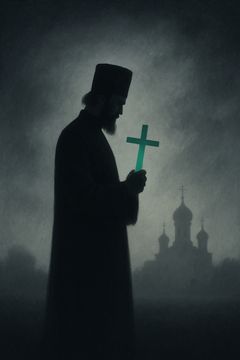
Kasatsky becomes the monk Father Sergius and eventually lives as a hermit. Visitors treat him as a holy man and healer. His reputation grows, but so does his unease.
The story follows his conflict with sexual desire, vanity, and the institutional machinery that turns spiritual fame into a public attraction.
The framing is severe but not merely sarcastic. Tolstoy contrasts ceremonial religion with acts of useful attention: reading the Gospels aloud, helping people write, settling quarrels, and working among ordinary families. The plot’s later movement is best discovered directly.
What matters for a first encounter is the pressure between an admired image and a life that must answer to other people’s needs.
How it was received
Because it appeared after Tolstoy’s death, Father Sergius did not receive the ordinary first-edition debate that surrounded his earlier novels. It became part of the late Tolstoy canon, read alongside his religious essays and moral tales. The Project Gutenberg edition identifies Aylmer and Louise Maude as translators and dates its own release to 5 February 2006.
The story has had a visible screen life. Yakov Protazanov directed a Russian film in 1918 starring Ivan Mozzhukhin. A second film, directed by Igor Talankin, appeared in 1978.
Those adaptations show why the text remains attractive to filmmakers: Kasatsky’s public gestures are visual, while his self-deception depends on close psychological narration. The work’s later reputation rests on that tension between spectacle and inward truth.
The publication date also places the story in a complicated cultural moment. Tolstoy’s late writings circulated under pressure from censorship, and his conflict with the Orthodox Church made any story about a monk politically and spiritually charged. Father Sergius is not a documentary portrait of monastic life, nor is its hero a transparent self-portrait.
It is a carefully made parable about the danger of turning moral effort into another form of self-display.
Kasatsky’s military past gives the early sections a vocabulary of promotion, command, and honor. The monastery does not erase that vocabulary; it translates it into rules of obedience, fasting, prayer, and reputation. Later, the crowds who seek Sergius’s blessing create a second public career around him.
Tolstoy’s irony lies in the repetition: the man who fled worldly admiration discovers that admiration can follow him into the hermitage. The final movement toward ordinary service therefore matters more than any miracle story attached to his name.
The numbered structure also makes comparison easy. One section may show public reverence, while another shows the private thought that contradicts it. Learners can collect repeated words and watch the moral vocabulary develop across the story.
Since the plot moves through officers, monks, visitors, peasants, and children, the text supplies a concrete range of registers without requiring a thousand-page novel.
Why it works for language learners
The narrative is shorter than Tolstoy’s major novels and divided into clear numbered sections. Its English combines military titles, Orthodox vocabulary, rural speech, and plain moral argument. Dialogue is especially useful because a single address can reveal rank or intimacy.
Public-domain phrases include “his beloved Tsar,” “he entered a monastery,” and “I believe.” Learners can track how words such as obedience, pride, and blessing shift from social behavior to spiritual vocabulary.
The short form rewards rereading aloud. Tolstoy places plain statements beside formal religious phrases, and the change in rhythm often signals a change in self-understanding. Learners can listen for repeated sentence patterns, especially when Sergius explains an action to himself.
Tolstoy also makes bodily detail carry ethical meaning. The officer’s posture, the monk’s habits, the crowd’s pressure, and the peasant household’s work all challenge abstract claims about holiness. That contrast gives the story its realism.
Learners can underline physical verbs and compare them with words for belief, shame, and authority; the pattern shows how the text tests spiritual language against lived action.
Sources
Source text / credits: Father Sergius — Wikipedia · Leo Tolstoy — Wikipedia · Project Gutenberg: Father Sergius
Frequently asked questions
How many chapters are listed for this edition of Father Sergius?
The catalog lists 8 chapters for this edition.
Where are the article sources?
The article lists its references in the Sources section at the end.
 Boyhood
 Childhood
 Family Happiness
 Hadji Murat
 Master and Man
 Resurrection