
BooksRussian classics
Master and Man
Explore Leo Tolstoy’s late short story Master and Man, its 1895 publication, moral reversal, reception, and practical value for English learners.
About the book
Master and Man by Leo Tolstoy: History and Reception
About the author
Leo Tolstoy was born at Yasnaya Polyana in Tula Governorate on 9 September 1828 and died at Astapovo station on 20 November 1910. He came from an aristocratic Russian family, studied at Kazan University, served in the army, and drew on military experience in Sevastopol Sketches. His early novels War and Peace and Anna Karenina established his international reputation.
In later life Tolstoy became increasingly concerned with Christian ethics, nonviolence, poverty, and the moral failure of wealth. He rejected the privileges of his class while remaining tied to the estate and family conflicts that surrounded it. That tension is central to Master and Man: its two travellers are not abstract examples, but people shaped by Russian property, rank, weather, and commerce.
How and when it was written
Tolstoy wrote the story in 1895, late in his career. It was first published in the Russian journal Severny Vestnik in 1895 and later appeared in English translation. The short story belongs to the period when Tolstoy’s fiction increasingly used a simple journey or crisis to test a moral idea.
The saved sources identify the year, publication history, and central contrast between Vasili Andreevich Brekhunov, a merchant, and Nikita, his employee. They do not name a detailed working title history, a surviving draft sequence, or a publisher for every translation. Those claims are left out.
The story’s compressed form makes its construction visible: a business errand becomes a hazardous ride through a snowstorm, and physical dependence changes the meaning of “master.”
The setting is not decorative. The road, horse, blowing snow, and failing light repeatedly challenge Vasili’s belief that money can command every circumstance. Nikita’s knowledge of work and weather is practical rather than theoretical, and the contrast gives the story its social geometry.
Tolstoy’s late style can therefore be read through action: decisions under pressure reveal values more clearly than speeches do.
What the story is about
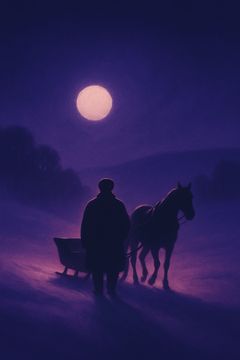
Vasili wants to buy a grove before another man can secure it. He sets out by horse with Nikita, a poor and capable worker. The men lose their way in a blizzard, return to the open snow, and struggle to keep the horse moving.
At first Vasili sees the trip in terms of profit and ownership, while Nikita bears the practical work. Cold, darkness, and exhaustion strip away their social distance. The plot remains deliberately narrow: the meaning comes from what each man does when comfort, money, and status no longer provide protection.
How it was received
The story is regarded as one of Tolstoy’s notable late works and is often discussed beside his moral essays and other short fiction. Its later reputation comes from the force of its reversal and its economical treatment of class. The supplied article names the 1895 publication in Severny Vestnik, but it does not provide a substantial list of contemporary reviews or sales figures; none is invented here.
Readers also value the story because its moral movement is inseparable from its physical movement. A change in direction on the road becomes a change in how one man sees another. That compact design has made the work suitable for classroom discussion and comparisons with Tolstoy’s longer examinations of conscience.
The story has been adapted and reinterpreted in theatre, film, and literary criticism, though the saved sources do not establish a complete adaptation list with years. Its influence is clearest in the many discussions of Tolstoyan ethics, where an ordinary journey becomes a test of responsibility.
Why it works for language learners
This is a shorter Tolstoy than the epic novelist. The journey gives learners repeated verbs of movement, weather, work, and bodily sensation. Dialogue is plain but socially marked: Vasili gives orders, while Nikita answers with practical knowledge.
The snowbound setting also recycles a small set of concrete nouns, making it possible to read closely without losing the thread.
The Gutenberg translation includes phrases such as “It was snowing hard,” “We have lost our way,” and “The horse stood still.” They are useful models for weather, present perfect, and simple narrative past. Learners can compare the direct speech with the narrator’s more formal descriptions.
The contrast between the two men gives learners a clear register map. Track the vocabulary of business, travel, discomfort, and conscience, then compare the narrator’s plain physical descriptions with the characters’ private justifications. Repeated verbs of choosing, stopping, seeing, and remembering make the novella manageable in short sessions despite its moral intensity.
The novella’s compressed length also helps learners practise inference. A repeated object or gesture can carry ethical weight, so mark concrete details before translating abstract claims. That sequence keeps the prose grounded while the characters’ motives become less comfortable.
Sources
Source text / credits: Master and Man — Wikipedia · Leo Tolstoy — Wikipedia · Project Gutenberg: Master and Man
Frequently asked questions
How many chapters are listed for this edition of Master and Man?
The catalog lists 10 chapters for this edition.
Where are the article sources?
The article lists its references in the Sources section at the end.
 Boyhood
 Childhood
 Family Happiness
 Father Sergius
 Hadji Murat
 Resurrection