
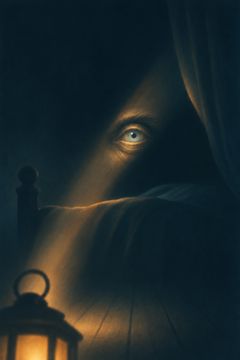
BooksHorror
The Tell-Tale Heart
Follow Poe's 1843 publication, unreliable narrator, Gothic technique, critical afterlife, and practical language-learning value in one short story.
Adapted reading example
An adapted reading example
This source-based editorial adaptation is not a quotation or a generated episode. Select the highlighted Spanish word to see its English meaning.
The Tell-Tale Heart · Editorial adaptation EN · ES The narrator insists that he is not mad, yet listens with unusual care and watches the old man’s each night before the room becomes completely still.
Source-based editorial adaptation; not a quotation or generated episode.
About the book
The Tell-Tale Heart by Edgar Allan Poe: History and Analysis
About the author
Edgar Allan Poe was born in Boston in 1809. His actor parents died while he was young, and John and Frances Allan of Richmond raised him, although they never formally adopted him. Poe attended the University of Virginia in 1826, left after financial difficulty, and entered the United States Army in 1827 under the name Edgar A.
Perry. He later studied at West Point but resigned in 1831.
Poe’s serious attempt to live by writing developed inside a precarious American magazine economy. John P. Kennedy helped him place stories and introduced him to Thomas W.
White, editor of the Southern Literary Messenger in Richmond. Poe worked there, married Virginia Clemm in 1836, and later edited or wrote for Burton’s Gentleman’s Magazine, Graham’s Magazine, the Evening Mirror, and the Broadway Journal. He was a critic as well as a fiction writer, and his theories about a single emotional effect illuminate the compressed design of “The Tell-Tale Heart.”
How and when it was written
“The Tell-Tale Heart” was first published in James Russell Lowell’s magazine The Pioneer in January 1843. Poe was likely paid ten dollars for it. The magazine was short-lived, so the story’s first appearance did not give it a long-running platform.
Poe later included the tale in collections and readings that helped establish his reputation for psychologically intense Gothic fiction.
The story’s construction reflects Poe’s preference for a concentrated effect. It does not provide a broad biography of its narrator or a detailed social history. Instead, it begins in the middle of a defensive address, repeats key sounds and words, and narrows attention onto an old man’s eye, a lantern, a floor, and a beating heart.
The prose moves between clipped declarations and spiralling explanations, making grammatical rhythm part of the suspense.
What the story is about
An unnamed narrator insists that heightened nerves should not be confused with madness. The narrator describes living with an old man, becoming obsessed with one disturbing eye, and planning a nighttime act with extraordinary care. After the act, visitors arrive because a neighbour has heard a noise.
The narrator welcomes the police and leads them into the house, confident that the evidence is hidden.
That is the setup, not the ending. Readers are placed inside a mind that argues for its own sanity while revealing fear through repetition, sensory detail, and sudden changes of pace. The story’s uncertainty comes less from supernatural events than from the narrator’s unstable account of perception, motive, and proof.
How it was received
The source material places the story in Poe’s productive period as a magazine writer and critic rather than documenting a long contemporary review campaign for this individual tale. Poe himself was better known during his lifetime as a literary critic, and James Russell Lowell called him one of America’s most discriminating and fearless critics of imaginative work.
Later readers grouped “The Tell-Tale Heart” with Poe’s Gothic and dark-romantic fiction, especially his recurring concerns with death, decomposition, premature burial, and the reanimation of the dead.
Poe died in Baltimore on 7 October 1849, six years after the story’s first publication. An obituary by Rufus Griswold damaged his reputation by presenting a distorted portrait, but later criticism recovered Poe’s technical influence. His detective tales helped establish modern mystery writing; his theory of a single effect influenced discussions of the short story; and his Gothic techniques shaped horror, crime fiction, film, theatre, and radio.
The story’s unnamed narrator and sonic climax have made it a frequent subject of classroom performance and adaptation, though the source does not identify a single first stage or screen version.
The story also belongs to Poe’s larger struggle to earn a living from American periodicals. Publishers often paid late or refused payment, and the absence of an international copyright law encouraged unauthorized British reprints instead of investment in new American writing. Poe edited Graham’s Magazine during a period when its circulation reached 25,000 subscribers, then pursued his own proposed journal, first called The Penn and later The Stylus.
This context makes the ten-dollar payment for the 1843 tale unusually concrete: a short, high-impact story was both an artistic design and a piece of magazine labor.
Poe’s critical principle was that every part of a serious work should strengthen one specific effect. In this tale, the effect is built from sound and insistence rather than from a large cast or changing setting. The narrator addresses an imagined listener, repeats “very” and “hear,” and uses semicolons to make one thought push into the next.
The police do not need elaborate forensic technology; the pressure comes from the narrator’s own performance. That design makes the story a useful meeting point between rhetoric and plot, because grammar itself becomes evidence of emotional change.
Why it works for language learners
The tale is brief, but its English is not simplistic. Learners can hear how punctuation, repetition, and short paragraphs represent a speaker trying to control an audience. The narrator uses direct address, rhetorical questions, past-tense sequencing, and precise household vocabulary.
Words such as “vulture,” “dreadfully,” “cautiously,” “dismembered,” and “concealed” gain meaning from physical action. Because the story stays close to one voice, it is excellent for noticing collocations and shifts from confident assertion to panic.
Useful short quotations from the Gutenberg text include “You fancy me mad,” “It was not the old man who vexed me,” and “The old man’s hour had come!” Their repeated pronouns and emphatic punctuation make them good shadowing material. In parallel text, learners can mark every verb of looking, hearing, and moving, then compare the narrator’s claim of calm with the sentence rhythm that contradicts it.
Reading it in LinguaLex
Read “The Tell-Tale Heart” in parallel text in LinguaLex, tapping a word for help while the narrator’s argument is still in view. The web app is in Open Beta, and the story’s compact length makes close rereading practical.
Sources
Source text / credits: The Tell-Tale Heart — Wikipedia · Edgar Allan Poe — Wikipedia · Project Gutenberg: The Tell-Tale Heart
Frequently asked questions
How many chapters are listed for this edition of The Tell-Tale Heart?
The catalog lists 1 chapters for this edition.
Where are the article sources?
The article lists its references in the Sources section at the end.
Is the reading card a chapter excerpt?
The card is a source-linked editorial adaptation, not a chapter quotation.
 Dracula
 Frankenstein
 The Phantom of the Opera
 The Picture of Dorian Gray
 The Strange Case of Dr Jekyll and Mr Hyde
 The Turn of the Screw