
BooksHorror
The Turn of the Screw
Study Henry James's 1898 ghost story through its framing device, publication history, critical debate, adaptations, and language-learning challenges.
About the book
The Turn of the Screw: History, Reception and Reading Guide
About the author
Henry James (1843–1916) was born in New York City into an intellectually ambitious family. His brother William became a major psychologist and philosopher; his father, Henry James Sr., encouraged wide reading and European travel. Henry studied in New York, London, Paris, and Geneva, attended Harvard Law School briefly, and chose literature instead of a legal career.
James lived for long periods in Europe, moving between American and British cultural worlds. His novels and stories examine consciousness, social perception, and the gap between what a person experiences and what can be proved. He became a British subject in 1915 and was buried in Cambridge, Massachusetts, after his death in 1916.
That transatlantic perspective helps explain the story’s English country-house setting and its intense attention to class, manners, and narration.
How and when it was written
The working method is important even when the sources do not give a day-by-day drafting diary. James makes the reader receive events through a first-person document enclosed inside another narrator’s scene. That architecture turns uncertainty into form: the question is not only what happened at Bly, but how a written testimony should be judged.
What the story is about
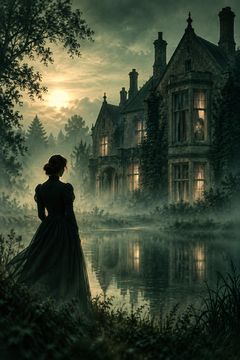
An unnamed governess accepts employment at Bly, an isolated Essex estate, to care for Miles and Flora, two children in the custody of their absent uncle. The uncle forbids her from troubling him with household problems. Soon the governess sees a man and woman who seem not to belong among the living.
She believes they are Peter Quint and Miss Jessel, former employees connected with the children. The plot’s setup depends on what she sees, what the children say, and what the house’s servants refuse to confirm; this guide avoids the ending.
How it was received
The novella quickly became a landmark of supernatural fiction, but its reception has never settled into one explanation. Readers and critics have argued for a literal haunting, a psychological projection, or a deliberate refusal to decide. Its ambiguity has driven adaptations for stage, opera, film, television, and radio, including Benjamin Britten’s opera The Turn of the Screw (1954).
The book’s later reputation rests less on sales figures than on its ability to make interpretation part of the reading experience.
The story also records the changing market for magazine fiction. James entered a popular periodical with a ghost narrative that had to grip readers while experimenting with point of view. His frame delays the governess’s voice, then asks readers to inhabit it intensely.
Children speak in ways adults must interpret; servants withhold information; the absent uncle’s instruction creates a practical vacuum. Every social relation affects what can be known. The novella’s uncertainty is therefore built into class, employment, childhood, and the authority granted to a young woman left alone with responsibility.
Why it works for language learners
James offers a concentrated challenge: long periodic sentences, indirect description, polite understatement, and a narrator who qualifies her own perceptions. The frame narrative gives learners two registers—the cultured host’s introduction and the governess’s urgent testimony. Chapters are manageable, but syntax can be dense.
Public-domain phrases to notice include “the little governess,” “a great vacant hush,” and “the story had been told.” Track pronouns and reporting verbs carefully; “I saw,” “I thought,” and “I felt” do not carry identical certainty.
Sources
Source text / credits: The Turn of the Screw — Wikipedia · Henry James — Wikipedia · Project Gutenberg: The Turn of the Screw
Frequently asked questions
How many chapters are listed for this edition of The Turn of the Screw?
The catalog lists 25 chapters for this edition.
Where are the article sources?
The article lists its references in the Sources section at the end.
 Dracula
 Frankenstein
 The Phantom of the Opera
 The Picture of Dorian Gray
 The Strange Case of Dr Jekyll and Mr Hyde
 The Tell-Tale Heart