
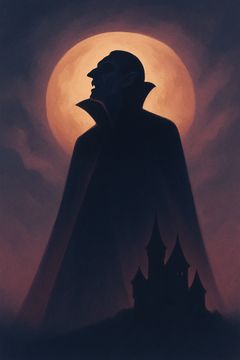
BooksHorror
Dracula
Trace Bram Stoker's Dracula from Irish theatre circles and Whitby research to its 1897 publication, critical afterlife, and learner-friendly Gothic prose.
Adapted reading example
An adapted reading example
This source-based editorial adaptation is not a quotation or a generated episode. Select the highlighted Spanish word to see its English meaning.
Dracula · Editorial adaptation EN · ES Jonathan travelled through the dark countryside toward the , where the driver and the waiting wolves made the last road to Count Dracula feel increasingly strange.
castle
Save word Words you save come back, woven into the chapters that follow.Source-based editorial adaptation; not a quotation or generated episode.
About the book
Dracula by Bram Stoker: History, Reception and Why Read It
About the author
Bram Stoker was born in Clontarf, Dublin, on 8 November 1847, the third of seven children. Illness made his early childhood unusually restricted: he was homeschooled before attending a private day school. In the 1860s he studied at Trinity College Dublin, and in the early 1870s he began writing theatre reviews.
A review of Henry Irving’s performance changed his professional life. The two men became friends, and in 1878 Irving offered Stoker the business-manager post at London’s Lyceum Theatre. Stoker accepted and married Florence Balcombe later that year.
The Lyceum made Stoker a working theatre professional rather than a secluded novelist. The job brought him into Victorian London’s social world and kept him close to Irving’s commanding performances. He supplemented theatre income with romance and sensation fiction, although contemporaries identified him more with the stage than with literary circles.
By his death in 1912 he had published eighteen books; Dracula was his seventh, between The Shoulder of Shasta (1895) and Miss Betty (1898).
How and when it was written
Stoker worked on Dracula mostly during the 1890s. He assembled more than one hundred pages of notes, combining plot outlines, chapter summaries, folklore, history, and travel information. The earliest dated note is 8 March 1890, an outline of the opening.
He researched at Whitby’s library during the summer of 1890 and also used the London Library. In February 1892 he had produced a twenty-seven-chapter outline, with the principal pieces already in place.
The name came from William Wilkinson’s 1820 history of Wallachia and Moldavia. Stoker copied its claim that Dracula meant “devil” and liked the name’s association with conspicuous courage, cruelty, or cunning. The typescript’s working title was The Un-Dead.
A last-minute change produced Dracula; the first known advertisement under that title appeared on 8 May 1897. Stoker even arranged a reading of his stage adaptation at the Lyceum in the week before publication, partly to protect adaptation rights.
Archibald Constable and Company issued the yellow-cloth, red-lettered first edition in May 1897, probably on 26 May, at six shillings. The publishing agreement was signed on 25 May. Stoker’s mother expected financial success, but the novel did not make him rich: he earned no royalties on the first thousand sales.
American newspapers serialized it before Doubleday & McClure brought out an American edition in 1899. A cheaper Constable paperback followed in 1901.
What the story is about
The novel is assembled from letters, diary entries, newspaper articles, and other documents, so no single narrator controls the whole account. It opens with Jonathan Harker, an English solicitor travelling to stay with a Transylvanian nobleman. Count Dracula’s apparently hospitable castle becomes the first stage of a much larger threat.
Dracula later reaches England and troubles the seaside town of Whitby. Harker joins a group led by Abraham Van Helsing, while Mina Murray and other characters piece together evidence from their separate records. This setup promises investigation, travel, suspense, and a clash between modern documents and ancient fear without revealing the ending.
How it was received
Reviews after the May 1897 publication often admired the novel’s terrifying atmosphere. Other reviewers found that Stoker supplied too much horror. Several noticed structural similarities to Wilkie Collins’s The Woman in White (1859), while others compared the book with Ann Radcliffe’s Gothic fiction.
The first reception therefore mixed praise for sensation with reservations about excess. It did not establish Stoker’s critical reputation during his lifetime, and it failed to earn substantial money.
The later story is very different. In the twentieth century critics came to call Dracula a seminal Gothic novel and to examine its Victorian arguments about race, religion, gender, and sexuality. It has never been out of print.
A 1914 collection issued “Dracula’s Guest” after Florence Stoker’s husband’s death; an edition edited by Raymond T. McNally and Radu Florescu in 1979 called it the novel’s “missing chapter.” The unauthorised film Nosferatu (1922) helped create the idea that sunlight kills vampires, although Stoker’s Dracula is weakened by sunlight rather than destroyed by it.
The novel’s characters and Count have since appeared in more than 700 media portrayals; Guinness has called Dracula the most portrayed literary character.
Its historical texture is more complicated than the familiar cape-and-castle image. Stoker borrowed some vampire traditions, including garlic and staking, but also invented rules: Dracula must be invited into a home, sleeps in earth from his homeland, and has no reflection. The novel does not use sunlight as the fatal weapon later films popularised.
Scholars have proposed Vlad III, Elizabeth Báthory, Irish folklore, and Henry Irving as inspirations, yet the source history stresses that there is no consensus about the historical figures. What is securely documented is Stoker’s research practice, his use of the name from Wilkinson, and his effort to make supernatural threat enter modern England.
Why it works for language learners
Dracula offers unusually clear practice in changing registers. Jonathan’s travel diary gives learners first-person observation, Mina’s records add purposeful domestic prose, newspaper items compress events, and Van Helsing’s speech has distinctive non-native English. The Victorian vocabulary can be demanding—“solicitor,” “carriage,” “telegram,” and “lunatic asylum” carry period context—but the documentary format creates frequent short entries and strong narrative signposts.
Learners can compare a formal report with a frightened private diary, then return to the same event from another voice.
The Gutenberg text supplies memorable, short phrases for close reading: “Listen to them—the children of the night,” “I am longing to be with you,” and “There are darknesses in life.” Tap each unfamiliar word in a parallel text, notice the punctuation around dialogue, and watch how repeated nouns build suspense. The story’s dates, place names, and travel movements also make it practical for practising past tense and prepositions.
Reading it in LinguaLex
In LinguaLex, read Dracula in parallel text, tap a word for help, and revisit a passage without losing your place. The web app is in Open Beta, so the documentary structure can support short, repeatable reading sessions.
Sources
Source text / credits: Dracula — Wikipedia · Bram Stoker — Wikipedia · Project Gutenberg: Dracula
Frequently asked questions
How many chapters are listed for this edition of Dracula?
The catalog lists 27 chapters for this edition.
Where are the article sources?
The article lists its references in the Sources section at the end.
Is the reading card a chapter excerpt?
The card is a source-linked editorial adaptation, not a chapter quotation.
 Frankenstein
 The Phantom of the Opera
 The Picture of Dorian Gray
 The Strange Case of Dr Jekyll and Mr Hyde
 The Tell-Tale Heart
 The Turn of the Screw