
BooksScience fiction
Twenty Thousand Leagues Under the Sea
Explore Jules Verne's submarine classic: its research, serial publication, reception, scientific vocabulary and value for English learners.
About the book
Twenty Thousand Leagues Under the Seas: History and Reception
About the author
Jules Verne (1828–1905) was a French novelist, playwright, and pioneer of science fiction. He was born in Nantes on 8 February 1828, a port city whose ships and maritime traffic gave his imagination a practical setting. Verne studied law in Paris, but theatre and writing displaced a legal career.
His collaboration with publisher Pierre-Jules Hetzel shaped the Voyages extraordinaires, a series designed to combine adventure, geography, science, and education.
Verne’s method was research translated into narrative momentum. He followed engineering developments, consulted technical material, and built plots around transportation systems that were new or newly imaginable. The submarine in this novel belongs to that method: it is an adventure machine, a scientific exhibit, and the private kingdom of Captain Nemo.
Verne’s interest in oceans also connects the book to the nineteenth-century expansion of marine exploration and illustrated popular science.
How and when it was written
The French title is Vingt Mille Lieues sous les mers. The novel was serialised from March 1869 to June 1870 in Hetzel’s fortnightly Magasin d’éducation et de récréation. Hetzel published a deluxe octavo edition in November 1871 with 111 illustrations by Alphonse de Neuville and Édouard Riou.
The illustrations were part of the reading experience: they made the submarine, underwater landscapes, and instruments visible to a mass audience.
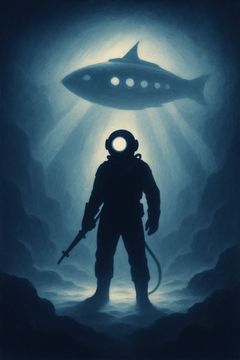
Verne took “Nautilus” from Robert Fulton’s submarine, built in 1800 and named for the chambered nautilus. He also studied the French Navy submarine Plongeur at the 1867 Exposition Universelle. The diving equipment in the story combines the surface-supplied hardhat suit with the self-contained apparatus designed by Benoit Rouquayrol and Auguste Denayrouze in 1865.
Those details show how the novel’s fantasy is anchored in contemporary engineering.
The serial form and illustrations shaped the original audience’s imagination. Hetzel’s 1871 deluxe edition contained 111 illustrations by Alphonse de Neuville and Édouard Riou, turning Nemo’s vessel and the underwater world into visible engineering fantasy. The first English translation, by Reverend Lewis Page Mercier in 1872, was not a transparent window onto Verne: it cut nearly a quarter of the French text and repeatedly mistranslated technical terms, including scaphandre as “cork-jacket.”
The adaptation history shows the premise’s durability. George Méliès made a film version in 1907, and Disney’s 1954 film brought the Nautilus to a new mass audience. Each version inherits the basic tension between scientific wonder and Nemo’s political isolation, even when it changes the route and tone of Aronnax’s voyage.
What the story is about
In 1866, ships from several nations report a mysterious sea monster, believed to be a gigantic narwhal. The United States government organises an expedition from New York. Professor Pierre Aronnax, a French marine biologist, accepts a last-minute invitation; Canadian harpooner Ned Land and Aronnax’s manservant Conseil join him.
After the encounter, the three men find themselves aboard the Nautilus, commanded by the enigmatic Captain Nemo. The setup promises underwater travel, conflict over freedom, and scientific wonder without disclosing the ending.
How it was received
The novel’s publication history helped establish Verne as a major writer of popular scientific adventure. Its first English translation appeared in 1872, by Reverend Lewis Page Mercier, but the source records serious problems: Mercier cut nearly a quarter of the French text and made hundreds of translation errors. “Scaphandre,” meaning diving suit, was repeatedly rendered as “cork-jacket,” changing the technical sense.
Later editions, translations, films, television versions, and undersea adventures kept Nemo and the Nautilus in cultural circulation. The book’s influence is especially visible wherever fictional submarines are treated as enclosed worlds with their own power systems, libraries, routes, and moral codes. Its scientific imagination remains inseparable from its argument about who controls technology.
Why it works for language learners
The novel suits advanced learners who enjoy technical compounds and descriptive lists. Aronnax’s narration supplies formal scientific English, Ned Land contributes blunt idiom, and Conseil often names things precisely. The voyage is divided into clear episodes, although the vocabulary can be dense.
Public-domain phrases include “The sea is everything,” “no equal in his dangerous trade,” and “Captain Nemo.” These short examples show a generalising statement, a superlative expression, and the name that becomes a recurring grammatical subject.
Sources
Source text / credits: Twenty Thousand Leagues Under the Sea — Wikipedia · Jules Verne — Wikipedia · Project Gutenberg: Twenty Thousand Leagues Under the Sea
Frequently asked questions
How many chapters are listed for this edition of Twenty Thousand Leagues Under the Sea?
The catalog lists 47 chapters for this edition.
Where are the article sources?
The article lists its references in the Sources section at the end.
 Journey to the Center of the Earth
 The Invisible Man
 The Time Machine
 The War of the Worlds
 A Connecticut Yankee in King Arthur's Court
 A Midsummer Night's Dream