
BooksScience fiction
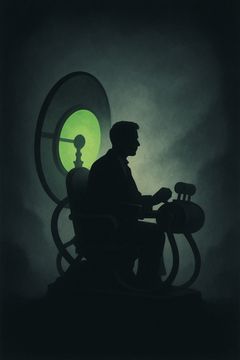
The Time Machine
Discover how H. G. Wells wrote The Time Machine, its Victorian science-fiction history, critical reputation, language-learning value, and lasting influence.
About the book
The Time Machine by H. G. Wells: Origins and Reception
Watch the story
Watch on YouTubeAbout the author
Herbert George Wells was born in Bromley, Kent, on 21 September 1866 and died in London on 13 August 1946. His working life ran from 1887 to 1946. He was not only a novelist: the surviving biographical record describes him as a teacher, historian and journalist, with interests in popular science, politics, social commentary and world history.
That range matters when approaching The Time Machine. The novel turns scientific speculation into a way of asking social and historical questions.
Wells studied at the Royal College of Science, where Thomas Henry Huxley was his academic adviser. He wrote more than forty novels and dozens of short stories. His early scientific romances arrived in a striking run: The Time Machine in 1895, The Island of Doctor Moreau in 1896, The Invisible Man in 1897, The War of the Worlds in 1898, and The First Men in the Moon in 1901.
That sequence helps explain why the 1895 book feels like both an experiment and a foundation stone. Wells was testing how a scientific premise could carry a novel, not merely decorating an adventure with technical language.
His politics and social thinking also shaped the book’s atmosphere. The author later joined the Fabian Society and wrote widely about progress, inequality and the future. He was nominated for the Nobel Prize in Literature in 1921, 1932, 1935 and 1946.
John Clute later called him the most important writer science fiction had yet seen, while Algis Budrys described him as an outstanding expositor of technology’s hope and despair. These later assessments are useful context, but they should not flatten the book into a prediction machine: its force comes from the unsettling human consequences of its thought experiment.
How and when it was written
The first publication year was 1895. Wells’s article history identifies the work as an early science-fiction novel and records several publication forms, including serialization in the periodical The New Review before the Heinemann book edition. Earlier versions used the working title The Chronic Argonauts.
The change to the compact title The Time Machine made the central device sound like an object, while the narrative itself keeps asking what sort of person would use it and what sort of society would result.
The story emerged from Wells’s interest in evolutionary theory, industrial modernity and class division. Rather than explain a machine through pages of engineering, Wells makes a first-person visitor demonstrate it to a dinner-party audience. The frame gives the impossible premise a social setting: skeptical listeners, a measured account, and physical evidence.
It also lets the book move between scientific vocabulary and sharply visual scenes.
The Project Gutenberg edition preserves the public-domain text and its chaptered progression. The short chapters and recurring return to the narrator’s house make the book unusually approachable for a nineteenth-century novel. Its historical importance is not just that it popularised time travel.
It helped establish the “scientific romance” as a form in which an invention could expose politics, class and the direction of civilisation.
What the story is about
At a London dinner, an unnamed inventor known as the Time Traveller argues that time is a dimension and presents a machine capable of moving through it. He makes a demonstration for his guests, then undertakes a much longer journey into the distant future. There he encounters the Eloi, a small and apparently gentle people living above ground, and begins to investigate the ruins and habits of the world around them.
His questions lead below the surface, where the Morlocks complicate his first impressions of the future. The narrative becomes an investigation: what happened to humanity, why are two kinds of people separated, and what does “progress” mean when viewed from far away? Readers can follow the mystery without needing advanced science.
The machine is a narrative key; the real subject is the history of a civilisation seen as a landscape.
How it was received
The book became one of Wells’s defining works and a central model for British and American science fiction. Later publishers and commentators repeatedly treated it as a genre landmark. John Clute placed Wells at the centre of the genre’s history; Hugo Gernsback reprinted most of Wells’s work in Amazing Stories, calling it central to the self-conscious new genre.
The influence reached Arthur C. Clarke, Brian Aldiss, John Wyndham, Ray Bradbury, Isaac Asimov, Frank Herbert, Carl Sagan and Ursula K. Le Guin, all of whom are recorded as acknowledging Wells’s importance or influence.
The work also travelled beyond books. Its title and premise became a template for later time-travel stories, while the wider Wells canon fed radio, cinema and television culture. The source record notes that impact craters on Mars and the Moon were named for Wells, a striking sign of how literary imagination and real space exploration became associated with him.
Jorge Luis Borges later included The Time Machine in a personal-library list alongside The Invisible Man.
Why it works for language learners
This is a good choice for learners who want clear narrative movement with some Victorian scientific vocabulary. The dinner-party frame introduces formal reporting verbs—“I told you so,” “you must follow”—before the prose shifts into sensory description and action. Learners can track the Time Traveller’s sequence of observation, hypothesis and revision.
The short chapter units make it practical to pause after a scene and check a new word without losing the larger argument.
Useful public-domain phrases include “The Time Traveller was expounding,” “We are always getting away from the present moment,” and “The machine was finished.” They show three different habits: a formal reporting verb, an abstract phrase about time, and a plain passive construction. Vocabulary such as “apparatus,” “dimension,” “laboratory,” “ruins” and “underground” repeats in meaningful contexts.
The book is challenging mainly because of its period syntax and philosophical vocabulary, not because the plot is hard to follow.
Sources
Source text / credits: The Time Machine — Wikipedia · H.G. Wells — Wikipedia · Project Gutenberg: The Time Machine
Frequently asked questions
How many chapters are listed for this edition of The Time Machine?
The catalog lists 12 chapters for this edition.
Where are the article sources?
The article lists its references in the Sources section at the end.
 Journey to the Center of the Earth
 The Invisible Man
 The War of the Worlds
 Twenty Thousand Leagues Under the Sea
 A Connecticut Yankee in King Arthur's Court
 A Midsummer Night's Dream