
BooksScience fiction
The Invisible Man
Discover how H. G. Wells wrote The Invisible Man, its scientific ideas, early reviews, adaptations, and why its clear prose suits English learners.
About the book
The Invisible Man by H. G. Wells: History and Reception
About the author
Herbert George Wells was born in Bromley, Kent, in 1866 and died in London in 1946. He grew up in a lower-middle-class household, worked as a draper’s apprentice, and won a scholarship to the Normal School of Science in London, where he studied biology under T. H.
Huxley. Teaching, journalism, and science shaped the explanatory energy of his fiction.
Wells’s early “scientific romances” include The Time Machine (1895), The Island of Doctor Moreau (1896), and The War of the Worlds (1898). He was interested in how an invention changes social power, not merely in machinery. The Invisible Man turns that question into a moral experiment: what happens when a person can act without being seen, and what restraints survive when ordinary accountability disappears?
How and when it was written
The novel was published in 1897, after appearing in serial form in Pearson’s Magazine. It was Wells’s third novel and was subtitled “A Grotesque Romance.” The science is fictional but the method is argumentative: Griffin explains his optical research, then the narrative tests it against weather, clothing, food, and human contact.
What the story is about
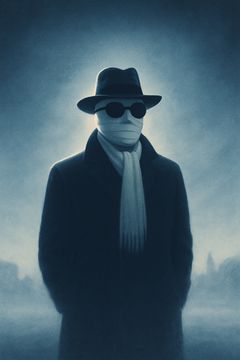
A stranger whose face and body are hidden by bandages rents a room at an inn. He insists on privacy, works with bottles and apparatus, and becomes increasingly angry when the villagers ask questions. His invisibility is not initially understood as a supernatural curse; it is presented as a scientific condition with practical problems.
The man is Griffin, a scientist who has discovered a process that makes the human body invisible. As he tries to secure clothes, money, and shelter, his isolation turns into coercion. The plot then moves from village suspicion to pursuit, police reports, and the effect of an unseen person on public order.
This setup avoids the resolution.
How it was received
The book established Wells as a major writer of speculative fiction. Contemporary readers responded to its combination of scientific plausibility, comic awkwardness, and menace. Later critics have often emphasized that Griffin is not a heroic invisible man: the power exposes his selfishness and makes a political question out of private freedom.
The novel’s influence is especially clear in adaptations. Universal’s 1933 film starred Claude Rains and became a landmark of special-effects horror. James Whale directed it, and the film’s voice and bandaged reveal shaped later screen versions.
The source also records a 1984 Soviet television adaptation, a 1989 BBC radio adaptation, and the 2020 film The Invisible Man, directed by Leigh Whannell and starring Elisabeth Moss; the last relocates Wells’s premise into a contemporary abuse thriller rather than directly filming the novel.
Why it works for language learners
Wells writes with direct narration and concrete verbs, making cause and effect easier to follow than in much Victorian fantasy. The short chapters move between dialogue, explanation, chase, and newspaper-like report. Learners meet period terms such as “chemist,” “inn,” “vicar,” and “constable,” while repeated references to clothing and weather reinforce context.
Useful public-domain phrases include “a strange man,” “the weather was bitterly cold,” and “the invisible man.” They are simple but show Wells’s habit of anchoring an extraordinary premise in ordinary sensory detail. A parallel version is helpful when Griffin explains optics, since the scientific vocabulary can become dense.
Wells’s science-fiction method is especially useful for language study because each impossible claim creates a practical consequence. If a body cannot be seen, how can it eat without revealing food, walk through mud without leaving tracks, or dress without becoming visible? Griffin’s explanations use the vocabulary of light, pigment, glass, experiment, and apparatus; village scenes then translate those abstractions into suspicion and fear.
The movement between explanation and action gives readers a reliable rhythm. It also keeps the social question in view: invisibility is not simply a trick, but a condition that removes ordinary witnesses and tests whether intelligence without restraint becomes cruelty.
The village setting keeps the novel grounded in institutions that learners can name: an innkeeper wants payment, a constable wants order, neighbours exchange rumours, and a scientist wants materials. Griffin’s extraordinary condition repeatedly collides with these ordinary expectations. That collision explains why Wells alternates scientific exposition with short confrontations.
The reader learns the rules of invisibility at the same time as the villagers learn that a hidden person can still have a voice, a footprint, or an appetite. The method is economical and cinematic, but the book’s real historical interest is ethical: late-Victorian faith in science is tested by the character who treats discovery as permission.
A useful learner exercise is to list every visible trace Griffin leaves behind: clothing, footprints, objects, sounds, and reports from witnesses. The list turns an abstract scientific premise into recurring English nouns and verbs. It also mirrors Wells’s narrative strategy, which makes the unseen legible through consequences.
When a later paragraph refers back to an earlier trace, readers can practise reference words and inference instead of translating every sentence independently.
The repeated village nouns also provide a useful glossary: inn, room, window, road, coat, bandage, and constable recur as the mystery becomes public. Learning them in sequence makes the later pursuit easier to picture and gives the scientific premise a firmly material vocabulary.
Sources
Source text / credits: The Invisible Man — Wikipedia · H. G. Wells — Wikipedia · Project Gutenberg: The Invisible Man
Frequently asked questions
How many chapters are listed for this edition of The Invisible Man?
The catalog lists 28 chapters for this edition.
Where are the article sources?
The article lists its references in the Sources section at the end.
 Journey to the Center of the Earth
 The Time Machine
 The War of the Worlds
 Twenty Thousand Leagues Under the Sea
 A Connecticut Yankee in King Arthur's Court
 A Midsummer Night's Dream