
BooksScience fiction
The War of the Worlds
Learn how H. G. Wells shaped his 1898 invasion novel, its scientific context, critical legacy, adaptations, and practical value for English learners.
About the book
The War of the Worlds: History, Reception and Reading Guide
About the author
H. G. Wells (1866–1946) was born at Bromley in Kent.
His father, Joseph Wells, had been a professional cricketer and shopkeeper; the family expected practical work, but an accident at fourteen ended Wells’s apprenticeship as a draper. He studied at the Normal School of Science in South Kensington under T. H.
Huxley and qualified as a teacher of biology.
Wells’s science training became the engine of his fiction. Before The War of the Worlds, he published The Time Machine (1895), The Island of Doctor Moreau (1896), and The Invisible Man (1897). He also wrote journalism, social commentary, and later works about politics and history.
His knowledge of evolution, astronomy, and industrial society let him make an alien invasion feel like a report from a modern world rather than a medieval romance.
How and when it was written
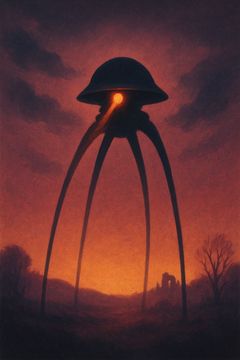
The novel appeared in 1898, after serialization in Pearson’s Magazine in Britain and the Cosmopolitan in the United States. Wells revised the text for book publication. The story’s Martians, heat-rays, tripods, and red weed turn contemporary assumptions about British power upside down: England becomes the invaded territory, observed by a narrator who tries to describe catastrophe with scientific and journalistic precision.
The book belongs to the late-Victorian “scientific romance” tradition. Its imaginative trigger is not recorded in the saved material as one single anecdote, so it is safer to emphasize the documented ingredients: Wells’s biology education, his earlier scientific romances, and the periodical market that carried the novel to readers in instalments.
The publication history identifies a transatlantic serial route: Pearson’s Magazine carried the story in Britain and Cosmopolitan in the United States before the 1898 book edition. A reader met the cylinders, machines, and fleeing crowds in instalments before the fixed volume shaped the invasion into a continuous narrative.
What the story is about
Strange cylinders fall near Woking, Surrey. At first, local observers treat the objects as curiosities. Then the visitors emerge and deploy machines unlike anything in the British arsenal.
The unnamed narrator separates from his wife and travels through a collapsing landscape, recording soldiers, refugees, ruined roads, and conflicting rumors. The opening promises invasion, but the emotional center is civilian survival and the struggle to understand technology that has outstripped familiar language.
How it was received
The novel became one of the foundational alien-invasion stories. Its influence reaches radio, film, television, comics, games, and later science fiction, with notable screen versions in 1953 and 2005. Orson Welles’s 1938 American radio adaptation became famous for causing reports of panic, though the scale of that panic has been debated.
The book’s later reputation also reflects its imperial reversal: readers can recognize how easily “civilization” language changes when the powerful become the hunted.
Wells’s invasion is a historical reversal. Britain was an imperial power in 1898, yet the novel imagines English towns as territory belonging to a technologically superior force. Roads, railway lines, telegraphy, newspapers, military orders, and rumors become the infrastructure through which people understand disaster.
Wells uses Surrey, London, and recognizable institutions rather than a medieval kingdom. The scientific romance therefore speaks both to Victorian confidence in progress and to fear that progress might belong to somebody else.
Orson Welles’s American radio broadcast came in 1938; major film versions followed in 1953 and 2005. Reports of panic around the radio version have been debated, so the safe historical claim is that the broadcast became a landmark adaptation whose reception became part of the novel’s cultural story.
Why it works for language learners
Wells alternates brisk action with explanatory passages, so the learner meets both concrete verbs and scientific nouns. The narrator uses formal Victorian vocabulary—“incandescence,” “carnage,” “perambulator”—but the danger keeps sentences moving. Chapters form strong travel units, and repeated location names reinforce listening and reading memory.
Try the public-domain phrases “no one would have believed,” “the heat-ray,” and “a tumult of voices.” Learners should watch the difference between eyewitness reporting and speculation: the narrator often marks what he knows, guesses, or hears from others.
Use “no one would have believed” as a grammar lesson in hindsight, then pair it with “the heat-ray” and “a tumult of voices.” Learners can sort nearby sentences into observation, report, and inference, following the narrator’s changing certainty.
Sources
Source text / credits: The War of the Worlds — Wikipedia · H. G. Wells — Wikipedia · Project Gutenberg: The War of the Worlds
Frequently asked questions
How many chapters are listed for this edition of The War of the Worlds?
The catalog lists 17 chapters for this edition.
Where are the article sources?
The article lists its references in the Sources section at the end.
 Journey to the Center of the Earth
 The Invisible Man
 The Time Machine
 Twenty Thousand Leagues Under the Sea
 A Connecticut Yankee in King Arthur's Court
 A Midsummer Night's Dream