
BooksAdventure
Treasure Island
Trace Treasure Island from Stevenson's serial experiment to a pirate-story blueprint, with history, reception, vocabulary and learner guidance.
About the book
Treasure Island: History, Reception and Why Read It
About the author
Robert Louis Stevenson was a Scottish novelist, poet, essayist, and travel writer, born in Edinburgh on 13 November 1850. He came from a family of lighthouse engineers and grew up amid the technical and maritime culture of Scotland. Although he studied engineering at Edinburgh University, chronic illness redirected him toward letters.
He qualified for the Scottish bar in 1875 but did not build a legal career. Travel, illness, and a restless interest in adventure became central to his writing life.
Stevenson travelled in France and elsewhere in Europe, married Fanny Van de Grift Osbourne in 1880, and later lived in the Pacific. His earlier works included travel writing and the historical romance Kidnapped (1886). The combination of Scottish historical storytelling, travel experience, and a sharp ear for spoken character prepared him to make a boys’ adventure both vivid and structurally exact.
Treasure Island is not simply an invented island: it turns books, maps, ships, and colonial travel into a child’s education in judgment.
How and when it was written
The novel first appeared as a serial in the children’s magazine Young Folks from 1881 to 1882. Stevenson used the working title The Sea Cook: A Story for Boys and, during the serial stage, the title Treasure Island or the Mutiny of the Hispaniola. A pseudonym, “Captain George North,” was also associated with the early publication.
Cassell & Co. issued the book on 14 November 1883; the first edition ran to 292 pages.
The serial form encouraged cliff-hangers and strongly marked episodes. Stevenson’s historical setting is the eighteenth century, but the book’s publication moment belongs to Victorian children’s literature and the expanding market for adventure. The prose keeps the machinery of a sea voyage legible: a schooner, watches, crew discipline, a chart, and competing loyalties.
Its famous pirate imagery emerged from a careful sequence of practical choices rather than from a loose collection of swashbuckling scenes.
The book’s afterlife shows how quickly a printed adventure became a performance tradition. Walt Disney’s 1950 film, directed by Byron Haskin, was the first completely live-action and first colour screen version of Treasure Island. It was filmed in Britain, used the real nineteenth-century schooner Ryelands for ship scenes, and earned $4.1 million in worldwide rentals.
What the story is about
Jim Hawkins lives at the Admiral Benbow inn when a mysterious old sailor arrives with a sea chest and a fear of blackmailing shipmates. After violence and discovery, Jim comes into possession of a map connected with Captain Flint’s buried treasure. Dr Livesey and Squire Trelawney organise an expedition from Bristol aboard the Hispaniola, commanded by Captain Alexander Smollett.
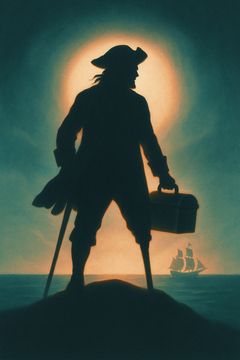
Jim meets the one-legged cook Long John Silver, whose warmth and intelligence make the voyage morally complicated. The setup includes a crew, a secret mutiny, and an island; it does not reveal the outcome.
How it was received
The book became one of the most frequently dramatised and adapted novels. Its cultural influence is unusually concrete: a tropical island, a treasure map marked with an “X,” a one-legged sailor, and a parrot on his shoulder became standard pirate shorthand. The source also identifies the novel as a coming-of-age story, not merely an adventure, because Jim’s movement through danger changes his understanding of adults and authority.
The serial and book histories matter to its reputation. Readers first encountered the story in instalments, then received the fixed Cassell volume in 1883. Later theatre, film, television, and illustrated versions repeatedly returned to Silver, Jim, Flint, and the Hispaniola, making the novel a reservoir from which modern pirate fiction continues to borrow.
The 1950 adaptation also left a documented critical trace. The New York Times critic Thomas M. Pryor reviewed it on 16 August 1950 as “a grand and glorious entertainment,” while Variety praised its set pieces and Robert Newton’s performance.
Why it works for language learners
Jim’s first-person narration makes the action easy to track, while nautical vocabulary supplies a focused challenge: “schooner,” “mate,” “mutiny,” “billet,” and “soundings.” Chapters are compact and end with changes in danger or knowledge, which rewards regular reading. The text also contrasts Jim’s straightforward report with Silver’s persuasive dialogue.
Public-domain examples include “Pieces of eight!”, “The dead man’s chest,” and “I was afraid of nothing.” They demonstrate an exclamation, a compressed noun phrase, and the narrator’s direct confidence.
One concrete close-reading exercise is to compare Jim’s blunt report, “I was afraid of nothing,” with the danger around him in the same episode. The sentence is short, but its past-tense “was” belongs to a narrator looking back, so confidence and memory are both present. Learners can mark commands and nautical nouns in the surrounding passage.
Sources
Source text / credits: Treasure Island — Wikipedia · Robert Louis Stevenson — Wikipedia · Project Gutenberg: Treasure Island
Frequently asked questions
How many chapters are listed for this edition of Treasure Island?
The catalog lists 34 chapters for this edition.
Where are the article sources?
The article lists its references in the Sources section at the end.
 Robinson Crusoe
 The Count of Monte Cristo
 The Jungle Book
 The Three Musketeers
 A Connecticut Yankee in King Arthur's Court
 A Midsummer Night's Dream