
BooksAdventure
The Three Musketeers
Follow Alexandre Dumas's 1844 adventure from historical sources and serialization to its reception, adaptations, and lively language for learners.
About the book
The Three Musketeers: History, Reception and Reading Guide
About the author
Alexandre Dumas (1802–1870) was born in Villers-Cotterêts, France. His father, General Thomas-Alexandre Dumas, had served in the French Revolutionary armies; the general’s death in 1806 left the family with limited means. Alexandre moved to Paris in 1822, worked as a notary’s clerk, and entered literary life through theatre and journalism.
His historical imagination was already visible in plays and collaborations before the musketeers. Dumas worked with Auguste Maquet, whose research and drafting assistance became important to several historical novels. Dumas’s prose is strongly theatrical: entrances, reversals, disguises, insults, and rapid changes of allegiance create scenes that could be staged as readily as read.
His enormous output included The Count of Monte Cristo, plays, memoirs, and travel writing.
How and when it was written
The novel combines real names—Cardinal Richelieu, Queen Anne of Austria, Buckingham, and Louis XIII—with invented or heavily fictionalized episodes. That mixture is not an error to correct; it is Dumas’s method. History supplies political pressure, while invented camaraderie supplies momentum and emotional clarity.
What the story is about
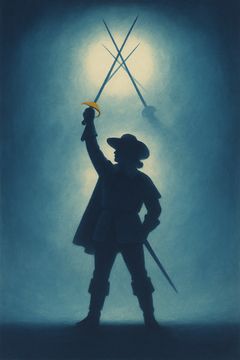
The young Gascon d’Artagnan leaves home for Paris carrying a letter of introduction. He crosses paths with Athos, Porthos, and Aramis, three musketeers whose quarrels become an alliance when the four men face the cardinal’s guards. Their “one for all, all for one” friendship draws them into court intrigue, duels, missions, romance, and international danger.
The setup introduces the central loyalties without revealing the later turns involving Milady or the Queen’s jewels.
How it was received
The novel became one of Dumas’s defining successes and the source of a durable popular tradition. Its influence is visible in repeated stage, silent-film, cinema, television, radio, and animated adaptations; the title’s four-way friendship has become a cultural shorthand. Adaptation dates vary across the many versions, so the saved source supports the broad claim of continuing adaptation more securely than a complete list.
Later readers have often valued its pace and wit more than strict historical accuracy, while scholars continue to discuss collaboration, authorship, and the politics of its romanticized France.
Dumas’s historical method rewards preparation. Louis XIII’s court, Richelieu’s authority, the musketeers’ military identity, and the geography of Paris and La Rochelle appear as social facts before becoming adventure machinery. The novel is not a neutral textbook of seventeenth-century France: it arranges real figures around invented loyalties and gives speed priority over archival precision.
Each encounter clarifies a relationship, and a repeated name can carry a promise of danger or rescue. Dumas makes friendship physical: companions arrive together, draw weapons together, and interrupt one another. Allegiance is embedded in action rather than explained abstractly.
Why it works for language learners
This is a good choice for learners who like action and conversation. Dumas moves quickly from narration to shouted challenges, formal address, and comic banter. Many chapters have a self-contained incident or cliffhanger, although names, titles, military vocabulary, and seventeenth-century etiquette can slow beginners.
Useful public-domain phrases include “All for one, and one for all,” “I am a musketeer,” and “the cardinal’s guards.” Watch how exclamation marks and direct speech carry urgency; the plot makes repeated vocabulary memorable because the same allies and enemies keep reappearing.
Sources
Source text / credits: The Three Musketeers — Wikipedia · Alexandre Dumas — Wikipedia · Project Gutenberg: The Three Musketeers
Frequently asked questions
How many chapters are listed for this edition of The Three Musketeers?
The catalog lists 67 chapters for this edition.
Where are the article sources?
The article lists its references in the Sources section at the end.
 Robinson Crusoe
 The Count of Monte Cristo
 The Jungle Book
 Treasure Island
 A Connecticut Yankee in King Arthur's Court
 A Midsummer Night's Dream