
BooksAdventure
The Jungle Book
Read the history of Kipling's Jungle Book, its Indian settings, composition, reception, adaptations, and practical English-learning strengths.
About the book
The Jungle Book by Rudyard Kipling: History and Reception
About the author
Rudyard Kipling was born in Bombay in 1865 and died in London in 1936. His father, John Lockwood Kipling, was an artist and educator; his mother was Alice Macdonald. Kipling spent his early childhood in India, was sent to England for schooling, and returned to Lahore in 1882 to work as a journalist.
Newspapers taught him compression, vivid description, and the value of a memorable refrain.
He later lived in Allahabad, worked for the Pioneer, and travelled widely in India. His early collections include Departmental Ditties (1886) and Plain Tales from the Hills (1888). Kipling moved to England in 1889 and became internationally famous.
His knowledge of Indian landscapes, colonial institutions, animals, and languages informs The Jungle Book, even though the animal fables are shaped works of literary invention rather than field notes.
How and when it was written
The Jungle Book was published in 1894 by Macmillan. It is a collection, not a single continuous novel: Mowgli’s stories are interspersed with tales such as “Rikki-Tikki-Tavi,” “The White Seal,” and “The Elephant’s Child.” Each story is followed by a poem, giving the book a deliberately varied rhythm.
Kipling wrote the Mowgli material while living in Vermont with his American wife, Caroline Balestier, and their children. The source connects the book’s composition with his memories of India and with the influence of his father’s stories and illustration. Its famous “Law of the Jungle” is a crafted literary code, not a transcription of animal science.
The saved material does not provide a full draft chronology or serialization history, so those details are omitted.
What the story is about
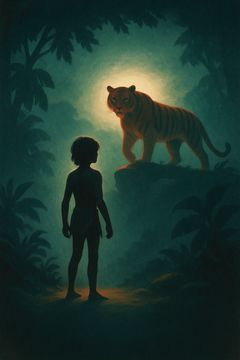
In the opening Mowgli story, wolves find a human child in the jungle and raise him as part of the pack. The tiger Shere Khan claims the child as prey, while the black panther Bagheera and the brown bear Baloo argue for his place among the wolves. Mowgli learns the jungle’s rules, language, and dangers as he grows.
The collection moves between Mowgli’s education and independent animal tales. Kipling’s India is full of rivers, villages, hunters, military camps, and forests; animals speak with distinct social codes and forms of authority. The premise is adventurous, but it also asks where a child belongs and what “law” means inside a community.
How it was received
The book was an immediate success and became one of Kipling’s best-known works. Its audience included children, but adults also recognized its formal ingenuity and political allegory. Kipling won the Nobel Prize in Literature in 1907, and the jungle stories have remained central to his popular reputation, even as later critics debate imperial attitudes in his work.
Adaptations have multiplied. The 1942 film Jungle Book was directed by Zoltán Korda. Disney released an animated The Jungle Book in 1967, followed by a live-action film in 1994 and Jon Favreau’s 2016 film.
The source also records television, stage, and radio versions. These adaptations often foreground Mowgli while selecting only a few stories from the original collection.
Why it works for language learners
The collection offers varied but manageable reading units. Narrative prose, animal dialogue, poems, songs, and repeated “law” language let learners compare registers. Kipling uses Indian words, animal names, and vivid verbs, yet each story provides strong context.
Mowgli’s lessons repeat vocabulary for movement, danger, family, and rules.
Public-domain phrases include “the Law of the Jungle,” “the Seeonee wolf-pack,” and “Now this is the Law.” The phrases are short enough to memorize and useful for noticing capitalization, rhythm, and collective nouns. Learners should expect older spellings and cultural vocabulary; parallel text makes those choices visible without flattening them.
The collection’s design is a strength for historical reading. Kipling’s prose carries traces of the newspaper writer: scenes begin quickly, a striking image fixes a location, and a conversation supplies the next turn. The poems interrupt that speed with refrain and pattern.
Mowgli’s stories use the pack, the Council Rock, Bagheera, Baloo, and Shere Khan as recurring anchors, while the separate tales change animals, settings, and moral pressure. That means learners can compare how a tiger’s threat, a mongoose’s alertness, and a seal’s journey are expressed without committing to a single long plot. The book also makes register visible: a law is recited ceremonially, a child asks direct questions, and animals use idioms that define membership.
The book’s reception should be read with its imperial context in mind. Kipling’s Indian settings are vivid, and his animals create memorable communities, but the collection was produced by a writer shaped by British colonial institutions and debates. That history does not cancel the stories’ craft; it gives learners an additional question to ask about who names a place, who makes a law, and who is allowed to belong.
The repeated code of the wolf-pack sounds universal because it is rhythmic and declarative. A careful reader can admire that technique while noticing that every “law” reflects an imagined social order. This combination of pleasure, history, and critical distance makes the collection unusually teachable.
A story-by-story reading plan also respects the book’s original variety. Read one Mowgli chapter beside its closing poem, then switch to an animal tale with a different setting and problem. Note which words signal command, warning, kinship, or movement.
Because the collection repeats patterns without repeating an entire plot, learners can build confidence through recognition while still meeting new vocabulary. That balance is one reason the book remains approachable in a historical edition.
The poems are particularly good for noticing sound. Refrains, alliteration, and parallel lines make unfamiliar words easier to remember, even when the syntax is older than everyday speech. Learners can read the prose for narrative clarity and the verse for rhythm, then compare what each form makes memorable.
Sources
Source text / credits: The Jungle Book — Wikipedia · Rudyard Kipling — Wikipedia · Project Gutenberg: The Jungle Book
Frequently asked questions
How many chapters are listed for this edition of The Jungle Book?
The catalog lists 15 chapters for this edition.
Where are the article sources?
The article lists its references in the Sources section at the end.
 Robinson Crusoe
 The Count of Monte Cristo
 The Three Musketeers
 Treasure Island
 A Connecticut Yankee in King Arthur's Court
 A Midsummer Night's Dream