
BooksComedy
Don Quixote
Discover how Cervantes created Don Quixote, how readers first received it, and why its comic, layered prose remains rewarding for English learners.
About the book
Don Quixote by Cervantes: History and Reception
About the author
Miguel de Cervantes Saavedra was born in Alcalá de Henares in 1547, the fourth of seven children. His family moved repeatedly, and by 1569 he was in Rome working for Cardinal Giulio Acquaviva. He joined the Spanish navy and fought at the Battle of Lepanto in 1571, where a gunshot permanently injured his left hand.
On the voyage home in 1575, Barbary pirates captured him; Cervantes spent five years enslaved in Algiers before his family and Trinitarian friars secured his ransom in 1580.
That biography matters to Don Quixote. Cervantes knew soldiering, captivity, debt, travel, and the precarious life of a minor official. After returning to Spain he worked as a commissary for the Armada and as a tax collector.
He married Catalina de Salazar y Palacios in 1584. His plays and pastoral novel La Galatea brought limited financial success, while imprisonment for accounting problems gave him a sharper view of institutions and people who live by stories about themselves.
How and when it was written
Cervantes’s first part appeared in Madrid in January 1605 under the title El ingenioso hidalgo don Quixote de la Mancha. Francisco de Robles published it, and Juan de la Cuesta printed it. The immediate success was substantial: the novel was reprinted in the same year and translated into English by Thomas Shelton in 1612.
A second authorized part, Segunda parte del ingenioso caballero don Quixote de la Mancha, arrived in 1615.
The gap between parts was not peaceful. An anonymous continuation by “Alonso Fernández de Avellaneda” appeared in 1614. Cervantes answered that rival book inside his own second volume, making authorship, readers, and false versions part of the fiction.
The first part’s design draws on the popular romance of chivalry: an aging country gentleman reads so many knightly adventures that he decides to become a knight himself. Yet the book continually interrupts that premise with narrators, manuscripts, inserted tales, and arguments about what counts as a true history.
What the story is about
Alonso Quixano renames himself Don Quixote, chooses an old horse as Rocinante, and recruits his neighbor Sancho Panza as squire. He sets out from La Mancha to correct wrongs and win honor for the imagined lady Dulcinea del Toboso. Sancho wants practical rewards, especially the governorship of an island.
Their travels bring them into collision with innkeepers, priests, barbers, merchants, shepherds, prisoners, and other travelers.
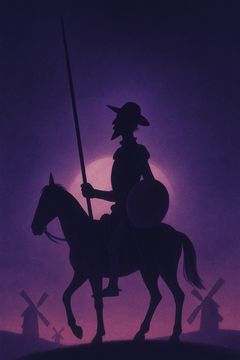
The famous windmill episode shows the method: Don Quixote sees giants where Sancho sees machinery. The joke is visual, but the relationship is more complex. Sancho learns to speak within his master’s imaginative world, while Don Quixote sometimes understands reality perfectly and sometimes refuses it.
The novel’s movement comes from that unstable partnership, not from an ending that should be spoiled.
How it was received
The first part was popular in Spain and quickly crossed borders. Shelton’s English translation appeared in 1612; French and Italian translations followed in the seventeenth century. Cervantes’s book became a European reference point for comic prose and for the contrast between idealism and ordinary life.
The 1614 pseudo-continuation made clear that the characters had already entered public culture while Cervantes was still writing.
Later critics disagreed about the balance between satire and sympathy. Eighteenth-century readers increasingly treated Don Quixote as a major novel rather than merely a parody of romances. Romantic writers, including Friedrich Schlegel and Victor Hugo, emphasized the hero’s imaginative dignity.
Modern criticism often stresses the book’s self-conscious narration, its social range, and its double view of reading as both liberation and danger. Its influence reaches the modern novel, theatrical adaptations, ballet, opera, film, and the phrase “quixotic,” used for impractical idealism.
The publishing history also explains why the book feels unusually alert to its own audience. Readers had already encountered characters who knew that a printed story could change their reputations when Cervantes released the second part. Don Quixote and Sancho are no longer simply wandering through a world that does not understand them; they are traveling through a world in which people have read about their earlier adventures.
That shift gives the second part a different kind of comedy and makes the novel an early meditation on celebrity, sequel, and unreliable narration.
The social range is equally important. Noble households, village laborers, innkeepers, soldiers, galley slaves, shepherds, and traveling students all enter the narrative. Cervantes does not give each group the same authority, but he lets many kinds of speech interrupt the polished language of romance.
A learner can therefore hear proverbs beside legal formulas, religious language beside jokes, and formal courtesy beside sudden insult. The mixture is part of the book’s historical record of early modern Spain, not decorative background.
The book’s humor also depends on collisions between literal and figurative language. A windmill is a machine and a giant only within a particular story; an inn can be a castle when ceremony supplies the missing architecture. Learners can mark these moments and ask which speaker controls the description.
That exercise turns vocabulary into interpretation and makes the historical parody easier to follow.
Why it works for language learners
This is demanding but unusually instructive English in Shelton’s older translation. The chapters are short enough to sample, dialogue changes register quickly, and narration often explains a joke after presenting it. Learners meet legal, military, rural, and domestic vocabulary in the same adventure.
A few memorable phrases from the public-domain text are “In a village of La Mancha,” “The truth may be stretched thin,” and “Sancho Panza, his squire.” The archaic spelling and long sentences reward a parallel edition: compare a phrase, then return to the scene’s action.
Sources
Source text / credits: Don Quixote — Wikipedia · Miguel de Cervantes — Wikipedia · Project Gutenberg: Don Quixote
Frequently asked questions
How many chapters are listed for this edition of Don Quixote?
The catalog lists 126 chapters for this edition.
Where are the article sources?
The article lists its references in the Sources section at the end.
 The Adventures of Tom Sawyer
 The Importance of Being Earnest
 The Pickwick Papers
 Three Men in a Boat
 A Connecticut Yankee in King Arthur's Court
 A Midsummer Night's Dream