
BooksComedy
Three Men in a Boat
Discover how Jerome K. Jerome turned a Thames holiday into a comic classic, from its 1889 publication to its lasting appeal for learners.
About the book
Three Men in a Boat: History, Reception and Why Read It
About the author
Jerome K. Jerome (1859–1927) was an English writer whose career crossed journalism, theatre, essays, and comic fiction. He was born Jerome Clapp Jerome in Walsall, Staffordshire, on 2 May 1859, and spent part of his childhood in poverty in London.
After leaving school, he worked on the railway before trying acting and reporting. Those jobs sharpened the conversational timing and social observation that later made his narrator sound like a companion rather than a lecturer. He adopted the name Jerome K.
Jerome, with the middle initial helping distinguish him from other Jeromes.
His first book, On the Stage—and Off, appeared in 1885. He edited The Idler and later To-Day, and his writing for comic periodicals gave him a laboratory for short scenes, self-mockery, and sharply timed reversals. Jerome was also a dramatist: Woodbarrow Farm was staged in 1894, and he wrote plays as well as novels.
The Thames setting grew from a familiar English leisure world—boating, camping, inns, locks, and historic villages—rather than from an exotic expedition.
How and when it was written
Three Men in a Boat (To Say Nothing of the Dog) was published in 1889 by J. W. Arrowsmith in Bristol and Simpkin, Marshall & Co. in London.
Jerome originally planned something closer to a serious travel guide, recording local history along the river. His comic material expanded until the guidebook framework became a vehicle for digressions, mishaps, and the narrator’s resistance to solemnity.
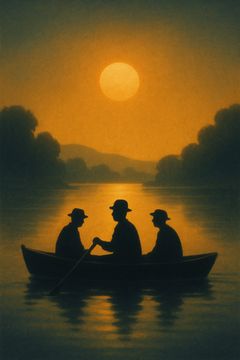
The route runs from Kingston upon Thames to Oxford and back, over a two-week boating holiday. The fictional party consists of George, Harris, Jerome—usually called “J.”—and Montmorency, the dog. Jerome’s decision to make the narrator one of the holidaymakers lets practical details and historical commentary collide with bad planning.
The book names Hampton Court Palace, Hampton Church, Magna Carta Island, and Monkey Island at Bray. Its original 1889 title already announced the comic contract: the dog is not decorative; he is a fellow traveller.
Jerome had begun with the idea of a serious river guide, but incidents and digressions took over. The result was issued by J. W.
Arrowsmith in Bristol and Simpkin, Marshall & Co. in London. Named landmarks let Jerome set a solemn historical paragraph beside a wet tent or a bad meal.
What the story is about
J., George, Harris, and Montmorency meet while imagining that they suffer from every illness they have read about. They diagnose the real problem as “overwork” and seek a cure in the countryside. A sea trip is rejected after J. recalls disastrous nautical experiences, so the friends choose the Thames.
They must organise a boat, food, camping equipment, and a route, while their confidence repeatedly outruns their competence. The journey supplies the plot, but the book’s true motion comes from anecdotes about fishing, weather, tents, bagpipes, and the history visible from the bank.
How it was received
The book became an overwhelming success, followed by Jerome’s 1900 cycling sequel Three Men on the Bummel (also known as Three Men on Wheels). Jerome later remembered hostile notices in The Standard and The Morning Post: he said The Standard called him a menace to English letters and The Morning Post treated him as an example of the lower orders being over-educated.
That recollection captures the split response: some critics distrusted popular comic writing, while readers made the book durable.
Its jokes were still being praised as fresh and witty more than a century after publication. The novel’s influence is less a single named adaptation than a continuing comic template: friends, a holiday itinerary, practical incompetence, and a narrator who turns a minor inconvenience into an epic. Its Thames landmarks also preserve a recognizable cultural geography alongside the farce.
The sequel Three Men on the Bummel appeared in 1900. Jerome later recalled that The Standard called him a menace to English letters and The Morning Post treated him as an example of the lower orders being over-educated, showing that popular success coexisted with class-coded hostility.
Why it works for language learners
This is useful intermediate-to-advanced English because the narrative alternates between plain dialogue, period idiom, mock-medical language, and descriptive travel prose. The chapters are episodic: a learner can finish one anecdote without holding a massive battle plot in memory. The narrator’s voice is informal but controlled, making it valuable for noticing understatement and comic exaggeration.
Short public-domain phrases include “To say nothing of the dog,” “we were suffering from overwork,” and “a two weeks’ holiday.” These lines show an aside, a mock diagnosis, and a compact period construction.
Read “To say nothing of the dog” beside “we were suffering from overwork.” The first is an aside that foregrounds Montmorency; the second adopts medical grammar for comic exaggeration. Learners can underline the pronouns and see how first-person plural turns discomfort into shared performance.
Sources
Source text / credits: Three Men in a Boat — Wikipedia · Jerome K. Jerome — Wikipedia · Project Gutenberg: Three Men in a Boat
Frequently asked questions
How many chapters are listed for this edition of Three Men in a Boat?
The catalog lists 19 chapters for this edition.
Where are the article sources?
The article lists its references in the Sources section at the end.
 Don Quixote
 The Adventures of Tom Sawyer
 The Importance of Being Earnest
 The Pickwick Papers
 A Connecticut Yankee in King Arthur's Court
 A Midsummer Night's Dream