
BooksHistorical
Ivanhoe
See how Walter Scott wrote Ivanhoe, why its medieval world captivated readers, and how its historical vocabulary can serve English learners.
About the book
Ivanhoe by Walter Scott: History, Reception and Reading Guide
About the author
Walter Scott was born in Edinburgh on 15 August 1771. A childhood illness left him lame, and he spent formative years with relatives in the Scottish Borders, where ballads, local history, and landscape became permanent sources for his imagination. He trained as a lawyer, became a solicitor and later Sheriff-Depute of Selkirkshire, and published poetry before turning decisively to prose fiction.
Scott’s Waverley appeared anonymously in 1814, followed by novels including The Antiquary and Rob Roy. His success made historical fiction a major commercial form. He was made a baronet in 1820, but expensive building and publishing ventures contributed to financial collapse in 1826.
Scott then wrote intensively to repay creditors. His professional knowledge of law, property, rank, and regional custom gives Ivanhoe more institutional detail than a simple adventure romance.
How and when it was written
Scott wrote Ivanhoe in 1819 and published it in December of that year. It was his first novel set in medieval England rather than Scotland. The title page called it Ivanhoe: A Romance, and the story is set in 1194, during the reign of Richard I.
Scott drew on medieval chronicles, antiquarian reading, and the political tensions between Saxons and Normans, while adapting the period for nineteenth-century readers.
The novel’s opening deliberately establishes a divided country: Norman authority governs a largely Saxon population, Richard is absent after the Crusade, and Prince John is trying to strengthen his position. Scott combines historical names with invented households and heroes. His dedication and introductory material also play with the question of how much a novelist may alter the past to make a living narrative.
What the story is about
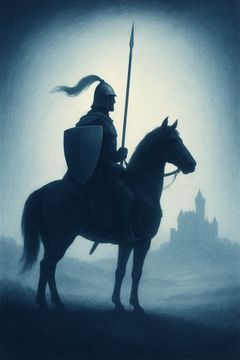
Wilfred of Ivanhoe is a disinherited Saxon knight returning from the Crusade. He supports King Richard, loves Lady Rowena, and has fallen out with his father, Cedric. The opening tournament introduces anonymous knights, rival loyalties, and the Jew Isaac of York with his daughter Rebecca.
Richard’s captivity and Prince John’s ambition create the political background for journeys, sieges, and disguises.
Robin Hood and the outlaw forest belong to the book’s broad imaginative world, as do Norman castles and Saxon feasts. Scott gives Rebecca some of the novel’s most memorable speeches, using her position to expose the violence hidden inside chivalric ideals. This is a setup only: the pleasure lies in watching identities, loyalties, and historical forces collide across the later chapters.
How it was received
Ivanhoe was an immediate bestseller and helped create a nineteenth-century fascination with medieval England. Contemporary readers admired its tournaments, castles, and strong visual contrasts. Critics also debated its historical liberties and its treatment of Jewish characters.
The novel’s popularity made Richard the Lionheart, Robin Hood, and the imagined world of knights more central to popular culture than their earlier chronicles alone would have done.
Its influence is extensive. Operas, stage versions, radio dramas, television serials, and films repeatedly adapt the tournament and castle material. Notable films include Richard Thorpe’s 1952 Ivanhoe starring Robert Taylor, Elizabeth Taylor, and Joan Fontaine, and a 1982 television adaptation.
The novel also shaped later historical romances, even when writers rejected Scott’s ornate narration or his idealized chivalry.
Scott’s historical imagination is not neutral. The novel makes Saxon and Norman conflict legible through recognizable types, but its Jewish characters expose the limits of the chivalric world that other scenes celebrate. Isaac and Rebecca are not merely decorative outsiders; their legal vulnerability and financial importance show how medieval romance depends on communities that the knights do not protect consistently.
Modern readers can admire the novel’s energy while noticing where its nineteenth-century assumptions distort the past.
The book’s architecture alternates public spectacle with private conversation. A tournament supplies banners, horses, champions, and rules, while a later room may turn on a single question about loyalty. This alternation keeps a long novel moving and helps learners divide it into manageable units.
It also explains the book’s adaptability: a filmmaker can stage the tournament, a radio producer can emphasize the voices, and a classroom reader can isolate a chapter’s argument about honor without needing the entire plot at once.
Scott’s narratorial voice can seem ceremonious, but that difficulty is patterned. He often introduces a landscape, names its history, and then narrows toward a person speaking. Learners can read the opening paragraph for place vocabulary, then switch to dialogue for shorter clauses and direct commands.
The contrast makes an apparently old-fashioned style more manageable than its first impression suggests.
Why it works for language learners
The Project Gutenberg edition is a substantial challenge: long descriptive sentences sit beside brisk dialogue, and the vocabulary includes heraldry, feudal law, clothing, weapons, and medieval institutions. Chapters are clearly marked, making a small daily portion realistic. Public-domain phrases include “In that pleasant district of merry England,” “the Black Knight,” and “the fair Jewess.”
Learners should expect archaisms, but recurring titles and character names make the social hierarchy visible.
The novel also offers repeated formulas of address: sir, my lord, knight, lady, and names accompanied by titles. These are not interchangeable. Their distribution teaches how status enters grammar and dialogue.
A reader who records who uses each form can follow the social stakes even when armor or architecture is unfamiliar.
Scott’s descriptions also teach how a historical narrator builds suspense before anyone speaks. A road, gate, banner, or horn can signal a change in political power. Learners can separate the descriptive clauses from the main action, then retell the scene in shorter English.
The exercise preserves the setting while making the syntax less overwhelming.
Sources
Source text / credits: Ivanhoe — Wikipedia · Walter Scott — Wikipedia · Project Gutenberg: Ivanhoe
Frequently asked questions
How many chapters are listed for this edition of Ivanhoe?
The catalog lists 44 chapters for this edition.
Where are the article sources?
The article lists its references in the Sources section at the end.
 A Connecticut Yankee in King Arthur's Court
 Les Misérables
 The Last of the Mohicans
 War and Peace
 A Midsummer Night's Dream
 A Tale of Two Cities