
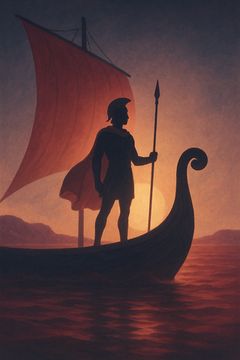
BooksClassics
The Odyssey
Follow The Odyssey from its oral Greek origins through English translation, critical afterlife, adaptations, and practical language-learning features.
About the book
The Odyssey: History, Homer and Why Read It
About the author
Homer is the traditional name attached to The Iliad and The Odyssey, but almost nothing secure is known about the person. Ancient biographies variously place him in cities including Smyrna and Chios and often describe him as blind. Modern scholarship treats Homeric authorship as a question rather than a settled biography.
The poems arose from oral traditions performed by aoidoi or rhapsodes before and alongside writing.
That uncertainty matters. The Odyssey is not a novel drafted by a traceable author in a known room. Its language belongs to a long performance tradition, and its formulaic phrases helped singers remember and audiences recognise scenes.
The poem was composed in Homeric Greek around the eighth or seventh century BC, according to the book’s historical account, and by the mid-sixth century BC it had entered the Greek literary canon.
How and when it was written
The Odyssey is divided into 24 books. It was transmitted orally while Greek literacy was developing through an alphabet adapted from Phoenician writing. Scholars do not agree on one composition date or on whether the Iliad and Odyssey came from one poet.
The oldest-known manuscript fragment mentioned in the source was produced in Ptolemaic Egypt during the third century BC and found at Medinet Ghoram.
The poem opens after the Trojan War rather than narrating the war itself. Its central journey lasts ten years, following a ten-year conflict. The first complete English translation appeared in 1616, while the Gutenberg text uses Samuel Butler’s translation.
Translation history is therefore part of the work’s afterlife: every English reader encounters both an ancient story and a later decision about rhythm, diction, and names.
What the story is about
Odysseus, king of Ithaca, is trying to return home. In his absence, Penelope faces suitors who consume the household’s resources, while their son Telemachus searches for news of his father. Athena encourages Telemachus to visit Nestor and Menelaus.
Odysseus is held by the nymph Calypso before the gods arrange his release; storms, islands, monsters, hosts, and stories then shape his route. This opening map reveals the stakes without telling the ending.
How it was received
The Odyssey has remained one of the central works of the Western canon. In a 2018 BBC Culture poll of experts around the world, it was chosen as literature’s most enduring narrative. Its influence includes the Latin Ulysses tradition, James Joyce’s Ulysses (1922), Margaret Atwood’s The Penelopiad (2005), and countless retellings for stage, film, television, and children.
The poem has also supplied modern words and archetypes: a long journey is an odyssey, and an idealised homecoming remains an odyssey’s emotional centre.
Ancient performance and modern adaptation are linked by selective retelling. Screen versions often focus on the Cyclops, Circe, or the return to Ithaca, while translations differ over whether the tone should sound ceremonial, plain, or contemporary. The poem’s reputation therefore comes not from one original edition but from repeated performances, manuscripts, translations, and reinterpretations.
The poem’s historical texture is visible in its treatment of performance. A bard sings at a royal court while characters listen, react, and sometimes ask for a different song. Stories inside the story make memory a public act: Odysseus shapes his identity by choosing what to narrate, while hosts preserve news of the war.
The poem therefore asks how reputation travels between islands and households.
The source records uncertainty about geography as well. Modern Ithaca may or may not be the island described by the poem, and scholars disagree about how much the route reflects real knowledge. That uncertainty is a reason to read the journeys as literary maps rather than travel instructions.
Why it works for language learners
The poem’s repeated epithets and formulaic introductions make patterns visible: names, genealogies, greetings, prayers, and speeches recur with variation. Its 24-book architecture gives learners clear stopping points, while the narrative moves between action and embedded storytelling. Vocabulary is archaic in places, but concrete nouns—ship, oar, shore, wine, palace, guest, storm—anchor the mythic material.
Learners can compare direct speech with narrative summary and practise past-tense sequencing.
Short phrases from Butler’s public-domain translation include “Tell me, Muse,” “I am Odysseus,” and “The sea was dark.” Mark the imperatives, first-person declarations, and simple descriptive clauses; then compare them with a longer speech. The recurring hospitality scenes are especially useful for learning requests, offers, and polite formulas.
The poem’s long reception also explains why no single translation can be called the Odyssey in English. George Chapman produced the first complete English translation in 1616; Samuel Butler’s version, represented by the Gutenberg text, is another historical voice. Modern translations may use contemporary syntax or verse, but all mediate Homeric Greek.
Comparing a repeated epithet or a speech opening across translations teaches learners that “original meaning” and “English wording” are related but not identical.
The Odyssey’s influence is not confined to retellings with the same names. The word “odyssey” entered ordinary English as a term for an extended, eventful journey, showing how a proper title became a common noun. That linguistic afterlife is a useful reminder that ancient literature survives not only in libraries and adaptations but in everyday speech.
Its 24-book division also gives a learner a reliable scale: one book can be read for plot, then revisited for an embedded tale, a prayer, or a speech. Repetition is structural rather than accidental, because the poem returns to home, recognition, and the obligations of a guest.
Sources
Source text / credits: The Odyssey — Wikipedia · Homer — Wikipedia · Project Gutenberg: The Odyssey
Frequently asked questions
How many chapters are listed for this edition of The Odyssey?
The catalog lists 24 chapters for this edition.
Where are the article sources?
The article lists its references in the Sources section at the end.
 Crime and Punishment
 Moby Dick
 The Brothers Karamazov
 The Iliad
 A Connecticut Yankee in King Arthur's Court
 A Midsummer Night's Dream