
BooksMystery
The Adventures of Sherlock Holmes
See how Arthur Conan Doyle built Sherlock Holmes through twelve 1892 cases, Victorian journalism, memorable dialogue, and a lasting detective legacy.
About the book
The Adventures of Sherlock Holmes: History and Reception
About the author
Arthur Conan Doyle was born in Edinburgh in 1859 to an Irish Catholic family. He studied medicine at the University of Edinburgh and qualified as a doctor in 1885. His medical training mattered to Sherlock Holmes: observation, diagnosis, and the disciplined handling of evidence became the detective’s habits.
Doyle practised in Southsea, Portsmouth, while trying to establish himself as a writer. Earlier fiction and historical novels had appeared before Holmes became his defining creation.
Doyle based Holmes partly on Dr Joseph Bell, his Edinburgh professor, whose quick deductions from a patient’s appearance impressed students. The author’s professional life also included journalism, political campaigning, historical writing, and later spiritualism. He was knighted in 1902 for services connected with the Boer War, not for the detective stories.
Doyle died in 1930, but Holmes’s voice—filtered through Dr John Watson—remained his most durable literary achievement.
How and when it was written
The Adventures of Sherlock Holmes is a collection of twelve stories rather than a continuous novel. The cases first appeared in the Strand Magazine in 1891 and 1892, with illustrations by Sidney Paget, and were collected in book form in 1892. That magazine setting shaped the reading experience: each instalment had a compact puzzle, a recognizable opening, evidence to follow, and a resolution.
The stories’ lengths vary, but most can be read as distinct episodes.
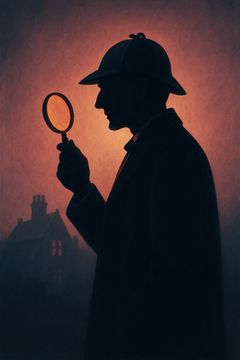
Doyle had already introduced Holmes and Watson in A Study in Scarlet (1887), then developed the pair through The Sign of the Four (1890). The Strand’s circulation and visual format gave the detective a much larger audience. Paget’s drawings also helped fix Holmes’s public image, including the deerstalker associated with later adaptations even though that costume is not the central feature of this collection.
Doyle’s medical observation, Bell’s example, and the period’s interest in scientific method all fed the stories’ construction.
What the story is about
Watson narrates most of the collection as case histories. Clients arrive at 221B Baker Street with missing documents, threatened reputations, impossible-seeming events, family secrets, or crimes that official investigators have failed to explain. Holmes studies small details, conducts experiments, disguises himself, and reconstructs a chain of causes.
Watson supplies companionship, admiration, and occasional surprise; his less complete understanding lets the reader investigate alongside him.
The twelve titles include “A Scandal in Bohemia,” “The Red-Headed League,” “A Case of Identity,” “The Boscombe Valley Mystery,” “The Five Orange Pips,” “The Man with the Twisted Lip,” “The Blue Carbuncle,” “The Speckled Band,” “The Engineer’s Thumb,” “The Noble Bachelor,” “The Beryl Coronet,” and “The Copper Beeches.” This list signals the collection’s range without disclosing solutions: royal embarrassment, fraud, disappearance, inheritance, violence, and locked-room fear all receive different investigative treatments.
How it was received
The Strand stories made Holmes widely popular, and the 1892 collection consolidated that success. The magazine’s accessible format, Paget’s illustrations, and Watson’s lively first-person narration helped turn a technically minded detective into a mass-cultural figure. Holmes became an international reference point for the detective story, while Doyle’s later writing included more Holmes collections, the historical novel The White Company (1891), and non-fiction on military and political subjects.
Doyle eventually grew tired of Holmes and killed him in “The Final Problem” (1893), causing public protest and subscription losses for the Strand according to the author biography. He later restored the detective in The Hound of the Baskervilles (1901–02) and The Return of Sherlock Holmes (1903–04). Holmes has influenced mystery writers, radio, theatre, film, television, and classroom exercises in reasoning.
Adaptations have repeatedly changed period, city, and technology while preserving the Watson-and-Holmes investigative partnership.
The economics of the collection are part of its history. Doyle was paid thirty guineas for each of the initial twelve Strand stories. The British first print run of the book reached 10,000 copies, while a further 4,500 copies were printed in the United States by Harper Brothers the following day.
Those numbers show why the collection was more than a private experiment in deduction: magazine serialization had already produced a readership ready to buy the volume. The stories also made Doyle one of the period’s best-paid and most famous authors. Their achievement was not simply a clever detective; it was a repeatable publishing form that could return readers to Baker Street each month.
The collection’s order also trains readers in Holmes’s method. “A Scandal in Bohemia” establishes Irene Adler as a formidable opponent, while “The Red-Headed League” turns an apparently comic job advertisement into a material clue. “The Speckled Band” concentrates fear inside a country house, and “The Blue Carbuncle” begins from an abandoned hat and a Christmas goose.
These contrasts prevent the twelve pieces from becoming interchangeable. Doyle repeatedly changes the first object of attention, then lets Holmes’s observation convert an ordinary detail into narrative evidence.
Why it works for language learners
This collection is especially useful for learners who benefit from short, self-contained chapters. Watson’s narration offers past-tense storytelling, reported speech, polite requests, and descriptive clues; Holmes adds commands, deductions, and compressed logical explanations. Victorian words such as “cab,” “telegram,” “lodging,” “divan,” and “constable” reward contextual guessing.
Because each case has a beginning, middle, and end, a learner can finish one episode and still retain the larger character relationship.
The Gutenberg text provides compact phrases to shadow aloud: “You see, but you do not observe,” “The game is afoot,” and “It is a capital mistake.” They are short enough to compare with the surrounding dialogue, yet rich in register and punctuation. Parallel reading makes Watson’s formal introductions easier to parse, while tapping a word for help keeps attention on evidence rather than sending the learner away from the case.
Sources
Source text / credits: The Adventures of Sherlock Holmes — Wikipedia · Arthur Conan Doyle — Wikipedia · Project Gutenberg: The Adventures of Sherlock Holmes
Frequently asked questions
How many chapters are listed for this edition of The Adventures of Sherlock Holmes?
The catalog lists 12 chapters for this edition.
Where are the article sources?
The article lists its references in the Sources section at the end.
 The Hound of the Baskervilles
 The Moonstone
 The Mystery of the Yellow Room
 The Sign of Four
 A Connecticut Yankee in King Arthur's Court
 A Midsummer Night's Dream