
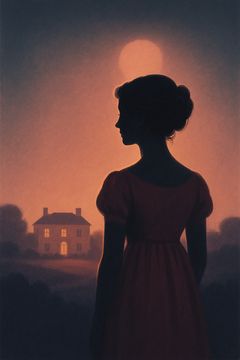
BooksRomance
Emma
Learn how Jane Austen wrote Emma, how critics responded, and what makes its witty dialogue and social vocabulary useful for English learners today.
About the book
Emma by Jane Austen: History, Reception and Reading Guide
About the author
Jane Austen was born on 16 December 1775 at Steventon Rectory in Hampshire, the seventh of eight children of George Austen and Cassandra Leigh. Her father was a clergyman who encouraged reading; the family circulated handwritten stories and owned a substantial library. Austen attended school briefly in Oxford and Southampton, then continued her education at home.
The lively household gave her close material for observing conversation, courtship, money, and rank.
Austen began writing The Watsons around 1804 but did not finish it. After her father’s death in 1805, she lived in Bath, Southampton, and finally Chawton, where her brother Edward provided a cottage. Her novels appeared anonymously: Sense and Sensibility in 1811 and Pride and Prejudice in 1813.
Austen died in Winchester on 18 July 1817, aged forty-one; Emma was the last novel published during her lifetime.
How and when it was written
Austen began Emma in January 1814 and completed it in March 1815. She told her niece that she intended to create a heroine whom nobody but herself would much like. John Murray published the novel in three volumes in December 1815, with a title page dated 1816.
Austen dedicated it to the Prince Regent, later George IV, whose librarian had conveyed the dedication request.
The book’s working circumstances were quiet but its method was ambitious. Austen restricts the narration closely to Emma Woodhouse’s understanding, allowing readers to notice errors before Emma does. The “free indirect” effect lets a sentence sound like both narrator and character.
The result is a comedy whose central subject is not simply marriage: it is the education of a clever, confident person who has been protected from consequences.
What the story is about
Emma Woodhouse is twenty-one, wealthy, and mistress of Hartfield in the village of Highbury. She has recently arranged what she believes is the successful marriage of her former governess, Miss Taylor, to Mr Weston. Convinced that matchmaking is her talent, Emma takes Harriet Smith under her protection and begins interpreting the village’s social signals.
Her friend George Knightley repeatedly warns that Emma’s confidence exceeds her knowledge. Emma’s father, Mr Woodhouse, fears change and worries about health; Jane Fairfax is accomplished but reserved; Frank Churchill is charming and absent for reasons the village cannot fully know. The plot advances through visits, dances, picnics, letters, and misunderstandings, so its social details matter as much as its declarations.
How it was received
The first reviews were favorable, though not all were enthusiastic about Emma herself. The Quarterly Review praised Austen’s ability to represent ordinary life, while the British Critic treated the novel as a clever comedy. Walter Scott, writing in the Quarterly Review in 1816, admired Austen’s command of “the exquisite art of painting from nature.”
The novel sold well enough for a second edition in 1816, but Austen’s name remained absent from the title page.
In the twentieth century, critics such as R. W. Chapman, F.
R. Leavis, and later feminist scholars made Emma central to Austen studies. Its reputation now rests on narrative irony, social observation, and the precision with which tiny acts—an invitation, a pause, a refusal—alter relationships.
Adaptations include the 1996 films directed by Douglas McGrath and Diarmuid Lawrence, the 1995 teen film Clueless as a modern transformation, and Autumn de Wilde’s 2020 film.
The publication details reveal Austen’s position in the literary marketplace. Emma was issued in three volumes, the format often called a three-decker, and the title page concealed the author behind the phrase “By the Author of Pride and Prejudice.” Austen’s correspondence shows her practical awareness of sales and reviews even while she avoided public literary celebrity.
The book’s economics also help explain why a successful novel did not automatically give its author independence: the second edition of Mansfield Park performed poorly and absorbed much of the income from Emma.
Highbury is small, but its map is not simple. Hartfield, Randalls, Donwell Abbey, and the Crown Inn organize who can visit whom, how long a journey takes, and which encounters appear accidental. Austen turns geography into social knowledge.
A reader learns that a carriage, a wet road, a late arrival, or a missing invitation can carry more information than an explicit declaration. This is why the novel rewards rereading: a seemingly casual sentence often records Emma’s mistaken theory while quietly giving the reader the evidence to correct it.
The novel’s chronology is similarly instructive. Characters remember earlier visits, postpone explanations, and reinterpret a conversation after a letter arrives. Austen rarely announces the lesson; she lets the reader compare what Emma believed with what later evidence establishes.
That pattern offers useful practice with reported speech, modal verbs, polite disagreement, and the vocabulary of probability.
Why it works for language learners
Emma is excellent for learners who want dialogue with social consequences. Chapters are moderate in length, scenes often take place in one room, and repeated forms of address reveal status. The challenge is indirectness: characters rarely say exactly what they mean.
Useful public-domain phrases include “I cannot make speeches,” “A young farmer, whether on horseback or on foot,” and “There is no charm equal to tenderness of heart.” Notice how Austen places politeness beside judgment; the vocabulary is accessible, but the implication is advanced.
Emma’s conversations are also a practical lesson in turn-taking. A question may be answered with a compliment, a pause, or a change of subject. Those moves are historically specific, yet recognizable to modern readers.
Learners can mark each evasive answer and ask what direct sentence the speaker avoids.
Sources
Source text / credits: Emma — Wikipedia · Jane Austen — Wikipedia · Project Gutenberg: Emma
Frequently asked questions
How many chapters are listed for this edition of Emma?
The catalog lists 55 chapters for this edition.
Where are the article sources?
The article lists its references in the Sources section at the end.
 Jane Eyre
 Pride and Prejudice
 Sense and Sensibility
 Wuthering Heights
 A Connecticut Yankee in King Arthur's Court
 A Midsummer Night's Dream