
Bilingual reader app: what to compare before you choose
Compare a bilingual reader app by text, lookup friction, story length, and support before you choose one for daily reading.
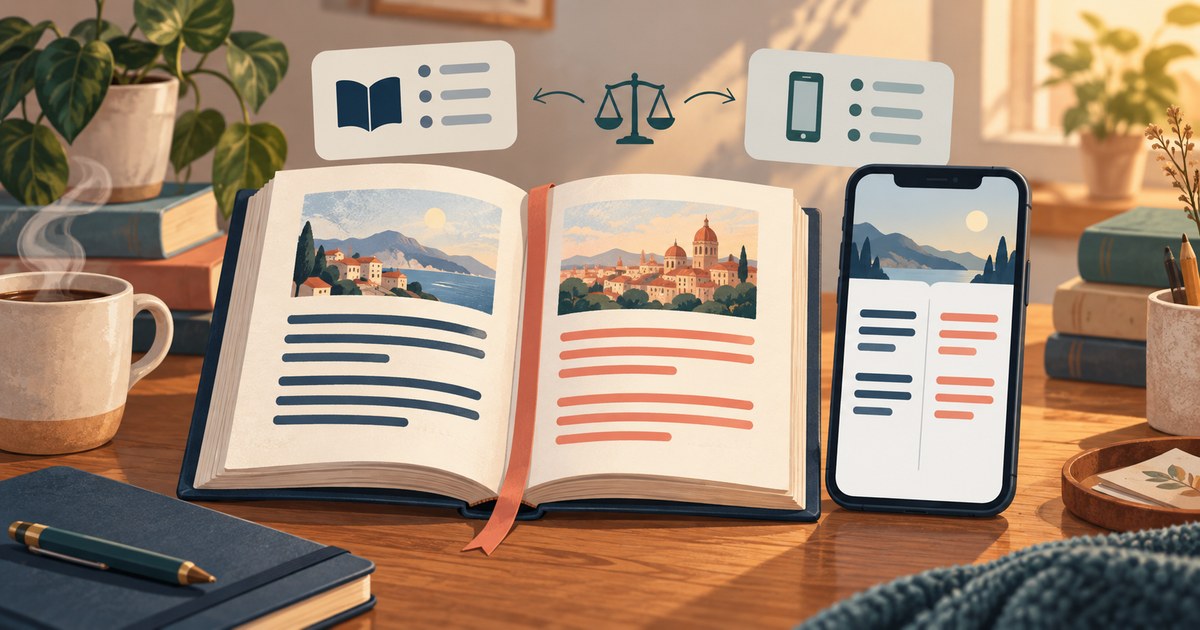
Choosing a bilingual reader app is less about finding the longest catalogue and more about finding a reading loop you will actually repeat. The wrong app sends you from a sentence to a dictionary, then to notes, then back to the sentence with the story gone cold. The right one keeps help close while leaving the story in charge.
I would test four things before comparing badges or screenshots: what you can read, how quickly you can get unstuck, whether the text fits your available time, and whether the app gives you a reason to return tomorrow. Product details change, so use this as a practical test rather than a permanent ranking.
Start with the text, not the feature list
There are two broad kinds of bilingual reader. One gives you a library of books, articles, or public-domain texts. The other creates or adapts shorter stories around a level, interest, or vocabulary. Both can be useful, but they answer different questions.
A library is a good choice when you already know what you want to read. You might want a familiar novel, a graded series, or an article about a subject you care about. Check that the language pair you need is really available and that the translation is complete. A large catalogue is not much help if the books you would open are missing.
Short personalised texts solve a different problem: you want a bridge between isolated vocabulary study and a full novel. A few minutes of a story can provide repetition and a natural stopping point. It does not replace reading ordinary books; it can make the next book less intimidating. Graded readers for language learning explains another version of the same bridge.
Before choosing, ask what happens after your first week. Can you name the next text you will read, or does the app depend on novelty? A useful reader makes the next session obvious.
Measure lookup friction
Every reading app says it helps with unknown words. The important question is what help feels like in the middle of a scene. Does the translation stay near the sentence? Can you check a word and return to the same line? Do you lose your place while opening a panel, selecting a dictionary, and closing it again?
Try a five-minute passage that is slightly above your comfort zone. Count neither every unknown word nor every tap. Notice whether the help lets you keep following the scene. A good bilingual layout makes support available before frustration wins, but quiet enough that you do not read the translation by reflex.
There is no single perfect amount of support. A beginner may need aligned translations. A more experienced reader may prefer a short definition. The useful test is whether the target language remains your first glance. Read it, make a small guess, then check the support when the meaning will not hold. Return to the original line after checking.
That return matters. It connects the meaning to the sentence instead of leaving you with a translation detached from its grammar, tone, and neighbours. Learning vocabulary in context is about this same difference between recognising a word and meeting it in use.
Check whether personalisation earns its place
“Personalised” should mean more than your name in a greeting. For a reader, it might mean a level that changes the language, stories that fit your interests, adjustable length, or a way to meet useful saved words again. Test the part that matters to you rather than accepting the label.
Save five words you genuinely want to understand. Read two short texts. Do the words return in sentences where they make sense, or do they appear as a list attached to an unrelated story? If the latter happens, the app may be giving you flashcards in a reading costume.
Personalisation also needs restraint. If a text is tuned so tightly that every sentence sounds artificial, the support is not worth much. If it ignores your level, it may be beautiful but exhausting. The best setting is the one that lets you follow a story while noticing the language you came to practise.
Let story length fit your life
Short texts are not inferior texts. A three-minute story can give you a complete scene, recurring vocabulary, and a clean place to stop. That matters on a tired weekday. Longer books teach you to carry meaning across chapters, but they are a poor test of whether an app can help you build a habit.
Try the smallest session first. Finish one scene, close the reader, and ask whether you would open it again tomorrow. If the answer is yes, increase the length gradually. If you want to move toward a novel, use short reading to train continuity, then apply the page test in how to read a book in a foreign language.
Compare cost with the reading you will do
Do not compare monthly prices in isolation. Compare what the free experience proves and how often you will use the product. A cheap subscription is expensive if it supplies novelty but no habit. A more expensive one can be sensible if it replaces several scattered tools and you read with it every week.
Before paying, check whether you can test the language pair and core reading support. Also check what happens if you stop using it. Do not subscribe for the imaginary version of yourself who reads an hour every night. Choose for the reader you are this week, then let a reliable habit grow.
A simple decision rule
Choose the bilingual reader that gives you text you want to open, help you can ignore until needed, and a next session that is easy to begin. Use a library when your motivation is a particular book. Use graded or personalised stories when the gap between your level and the books you want is still too wide. There is no reason to choose only one kind forever.
The goal is not to become loyal to an app. It is to read with enough ease that the app becomes less necessary. LinguaLex keeps dual-language reading close to short stories for that reason: the support should help you stay with the story, not become the main event.
Try the test with one free chapter
Read one short chapter in the target language. Keep the support line or translation nearby, but look at it only when a word blocks the scene. Then return to the original sentence and see whether you still know what happened.
If you finish with the story in mind, you have learned more than whether the interface looks polished. You have tested the one feature that matters most: whether tomorrow’s reading feels easy to start.